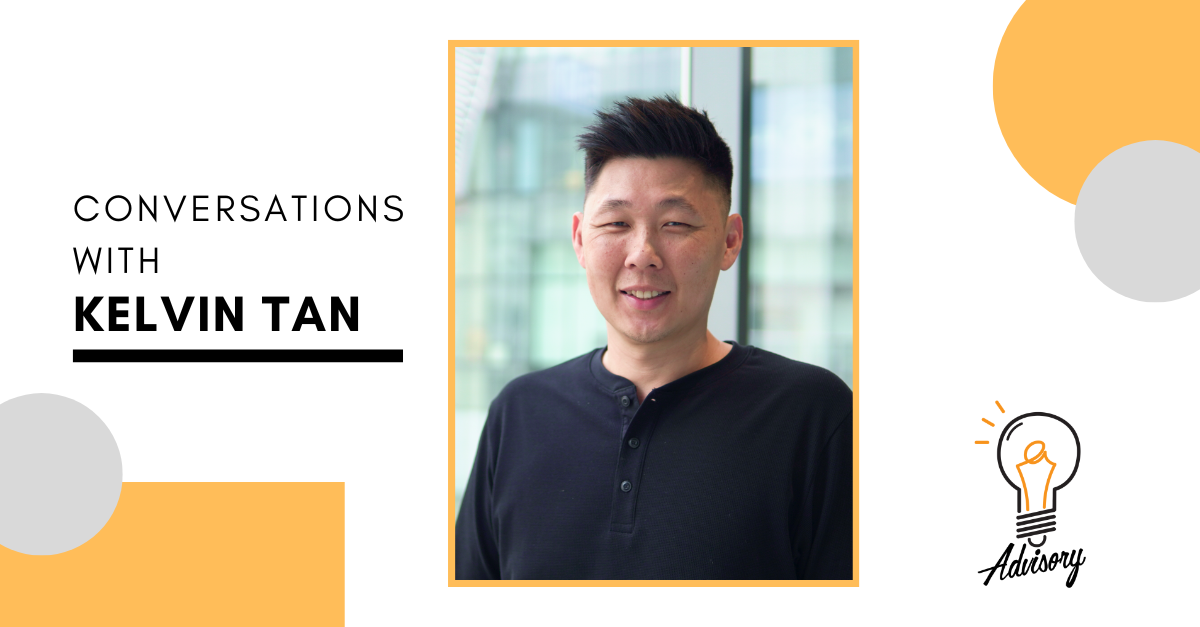
Conversations with Kelvin Tan
By Tan Beng Yang and Kayla Kam
Kelvin Tan is the CEO of audax Financial Technology, an enterprise fintech startup in Singapore. He has spent the last 20 years across a wide range of roles in banking, finance, consulting and FMCG (Fast Moving Consumer Goods). Prior to starting audax, he was the global head of Standard Chartered Nexus, the bank’s embedded finance endeavour.
What is audax?
Banks around the world are often stuck in legacy software, which requires massive maintenance costs. Audax offers a full-fledged bank-in-a-box software, including front-end apps, security, identity, access management, and other features. Our clients are generally large banks looking to modernise their software so that they are able to provide new digital business models at scale. These clients include but are not limited to Standard Chartered Bank, Maybank Islamic and Jeel.
What is your day-to-day life like?
I don’t usually have a single constant routine. Yesterday night, I was on a phone call with a client, the CEO of a North African bank, to assuage his concerns over delivery timelines. This morning, I cleared emails from international clients which arrived last night, before having a meeting to set this year’s priorities and measurable goals with the HR team. Afterwards, I met a client in Singapore for lunch in Raffles Quay, then came back to write a document for a board session in Dubai next week. I am out of Singapore at least two weeks a month.
How do you view your role as CEO of audax?
I view myself as the “ultimate coffee boy” to the rest of the team. Firstly, I am the morale leader of the company; how I express myself will affect my employees and their belief in what we do and why we do it. Secondly, I manage the quality of the people we hire, to safeguard the operating and cultural principles of the company, ensuring we have the right people in place for the right phase of the company as we continuously evolve. Lastly, I am the key decision maker when breaking deadlocks.
What are the downsides of working in your role?
I am online 16 to 20 hours a day, so my sleep sometimes suffers, and I also have to plan for the long-term future of the company. As a heavy introvert, having to ensure the satisfaction of many people is sometimes a little tiring.
What are the general principles you have had in your life over your whole career?
I change my career path regularly to seek new challenges, and have never had a long term plan. Despite my lack of finance background, I accepted an offer from OCBC over the Ministry of Foreign Affairs after graduating university in order to pick the road less travelled and moved to new industry verticals every few years whenever a new challenge came up. Several years ago, I pitched a change in the business model to the Group CEO of Standard Chartered where the bank can become an intermediary of data. He was interested, and audax began life as a business line within the bank before being spun off as a technology company providing a solution to banks. Always picking the road less travelled when given the option was how I stumbled into my different roles and how I am doing what I do today.
With the advent of AI, what would be replaceable or irreplaceable by it?
I think the AI conversation is part bubble, part truth. From using AI agents to help me summarise notes, schedule events, draft documents and do all my easily repeatable workflows, AI can definitely massively enhance productivity. However, it will also replace many junior roles. That being said, AI is not yet able to run fully autonomously at the level which is crucial for replacement of human beings, nor would it be desirable for it to be able to. I have not seen a coding agent that has built production-ready enterprise technology code independently.
What does coaching and elevating young Singaporean talent mean to you, and how do you do it?
I hope young Singaporeans can break out of the straitlaced mindset our education system places us into, which creates extremely good mid-level workers but not many standout senior leaders. I hope youth can take more risks - when given opportunities, saying yes rather than doubting their abilities. More importantly, Singaporeans take mistakes far too seriously and do not think sufficiently in terms of the worst case scenario. If you take on something and realise it is not for you, the worst that could happen is that you get fired and find something else to do.
What are three tangible steps a young person should take in order to better prepare for the world and plan out their career?
Firstly, you should have some experience living overseas, especially in Asia. Secondly, challenge yourself while you are young. The stakes are not yet high - you have no dependents, no mortgage, and time to bounce back from failures. Thirdly, find a mentor, someone 10 to 12 years older and three steps ahead in your career, to give you advice relevant to your context.