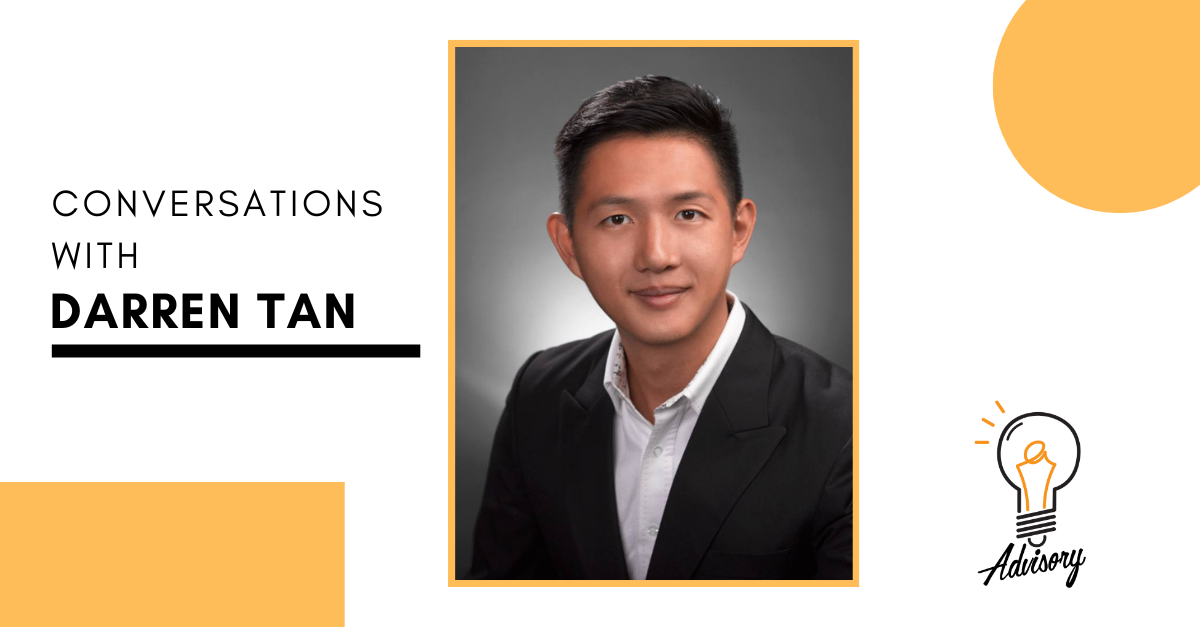
Conversations with Darren Tan
By Soong Hung Hao & Caitlin Goh
Darren Tan is the Chief Executive Officer (CEO) and Managing Director of U-Farm, a company that designs educational systems for corporations and schools while also advising on policy. He also served as the Head of Education and Community Outreach at ComCrop, one of Singapore’s pioneering local rooftop greenhouse farms.
Tell us about what you do
My role is a little complicated — I wear a number of hats. The main one, as you may call it, is a Chief Executive Officer (CEO) and Managing Director role of U-Farm. We design systems for education, which is meant for both corporations and schools. On top of that, we advise others on policy.
I also used to be the Head of Education and Community Outreach at ComCrop, a local farm. We are one of the first few rooftop farms in Singapore. Originally located at Scape, we eventually moved over to Woodlands and built Singapore’s first rooftop greenhouse farm.
Since then, we have been conducting outreach efforts. We help schools who want to educate their students through programmes and learning journeys. To be clear, U Farm is an offshoot of ComCrop; although it originated from the same company, they are separate entities now.
Where do you spend most of your time?
Most of my time is spent developing and running projects and programmes under U Farm. These could come in the form of workshops for school/corporates, or advisory projects for businesses related to agriculture or sustainability.
The team at ComCrop runs quite lean. They have mostly production staff — farm managers, assistant managers, and workers. I typically support areas that are not part of the farm’s core expertise. These are usually collaborations and Research and Development (R&D), which are not immediately related to production.
While my role is not explicitly defined, I take on the things that are out of the farm’s regular productions. This involves R&D for different crop types, potential collaboration with different agencies, and things of this sort.
Additionally, if external companies want to trial new farming models, I will take them on under U-Farm, if we have the space or expertise relevant to the project.
How has the industry been?
The demand for education on sustainability has been quite surprising. Education alone is a big pillar that can sustain a business.
When I had first started, there was perhaps one engagement every two to three months. Since then, thankfully, we have had a lot more engagements, and for a while, we were not able to meet all of the demand.
Specifically, schools request to come around the same time at the end of the school term because that is when the bulk of the learning journeys are scheduled. Thus, we have had to unfortunately turn people away, which you could say is a happy problem.
To continue running engagements in the interim periods, we engage with corporations. We help some of them maintain smaller scale farms, which are part of their own Environmental, Social, and Governance (ESG) initiatives. We bring our expertise to help them maintain their farms. This is important for these corporations, who may work with social service organisations; or use these farms as staff engagement and staff wellness spaces.
To be frank, the farming industry has been full of ups and downs. Government grants can be extremely supportive, but more than that, you really need the skill and knowledge of how to run a farm. There are farms that are too predicated on technology and economies of scale, which fail because they do not place enough emphasis on daily maintenance and daily business operations. This groundwork, which is not sexy, is important because it lays the foundations of the farm. So, when I educate corporations, I make sure that the information I share is both accurate and a good reflection of reality — to convey the right message, while balancing optimism with reality.
In farming, you should not overlook the importance of daily maintenance — keeping all the machinery running without hiccups. This requires a lot of expertise on hand to fix and troubleshoot these things. People often forget just how labour intensive the whole process is — washing, sanitising, and troubleshooting. There are also countless uncontrollable variables, such as the weather, plant illnesses, pests, so you have to look out for and manage these things.
What does a typical day for you look like?
Our services include regular garden maintenance for corporate clients and delivering sustainability or farming lessons. Notably, we run a program at a local school where we instruct children with mild intellectual disabilities in farming techniques. This initiative aims to provide them with valuable skills that will enable them to secure potential meaningful employment in the agricultural sector later in life.
The education provided aims to impart a strong understanding of food production, sustainability, and the interplay of technology and human skill, emphasizing the industry's crucial role in the future of food. When engaging corporations or schools, we share unique information and insights. For example, some information is best conveyed during a farm walk-through, while other details are better suited for an infographic or slides.
In my advisory role, I bridge the gap between innovation and commercialisation, particularly within the context of Singapore's push for food security. Many innovations emerge from research institutions, but they often fail to gain traction with farm operators. This is primarily because while these innovations frequently address problems deemed important by researchers, there are also the daily, urgent, and pressing issues faced by farms.
Furthermore, even when researchers do target farm problems, a lack of farmer involvement during the solution's conception creates a disconnect. This explains why many promising innovations never reach the market.
My core function is to guide researchers in developing products that are better aligned with farm needs and present a lower risk for adoption. This work is critical because securing farmer buy-in is often a Key Performance Indicator (KPI) for research grants, which in turn unlocks further funding. By leveraging my insights, I solve this disconnect: I identify the right industry partners who need the solutions and then facilitate the commercialisation of the researchers' work.
Are consumers aware of the need to support local?
Local production costs are high due to expensive rental and labour.
While a simple solution is to sell higher quality products, Singaporean consumers are very price sensitive and unwilling to pay more for vegetables. A small increase in vegetable prices can cause hesitation.
This reflects a fundamental disconnect: the perceived value of produce is very low. Farms struggle to sell enough produce to cover costs, which inhibits risk-taking, technology adoption, and upgrading.
A positive development is increased production capacity. The change needed is to encourage local vegetable consumption. Unlike overseas, where seasonal eating is common, Singapore lacks this concept (durian is the only truly seasonal fruit). Consequently, consumer habits, tastes, and preferences change too frequently and too fast for farmers to plan crops effectively.
What are the biggest challenges in your job?
It is a tough industry to me because it is neither extremely financially rewarding nor high in recognition. But for me, my passion is in learning and sharing; it is a joy to me to be able to share about the food industry in Singapore.
What were your past careers like? How did you get here?
I initially joined MFA to travel the world, and was assigned to the scholarships branch. There, I enjoyed speaking with potential scholars. After leaving MFA, I taught Physics and English for about seven years. Then, I traveled briefly before joining ComCrop. My Physics background was very useful, helping me understand research and distill it into operationally useful insights for the farm. I also pursued further education, including a course at Oxford and an Executive MBA, to aid in growing the business.
What advice do you have for people who would want to change jobs, seeing as you moved from teaching to farming?
I needed a new challenge because I was too comfortable with my teaching work, and my impact felt limited to my class or the level I managed. When that wasn't enough, I took a leap of faith to explore new possibilities.
For those in a similar spot, I'd say it's never too late to learn new things. Regardless of the industry, there are opportunities for you to gain many skills. These include technical skills and crucial soft skills like project management, communication, and negotiation, all highly applicable.
As a teacher, you must hold the attention of 40 often-distracted people, and you must simplify technical information into something accessible for students. Additionally, you manage projects, colleagues, and other relationships. These vital skills are extremely important in the private sector and shoule not be overlooked.
How do you manage to have a work life balance?
Success depends on its definition. Life involves juggling multiple priorities like money, family, relationships, recognition, health, and title. Like juggling, keeping all these "balls" in the air simultaneously is impossible; you must focus on a few.
This means accepting the sacrifice of less important things. For me, family, relationships, and well-being are the priority, though these change with age.
I believe it's impossible to have an amazing career, earn substantial money, and maintain all relationships and health. Only those who can extensively outsource—like housework or childcare—seem to manage it. Something has to give.
My personal advice is not to chase recognition or money.