
Conversations with Ian Chung
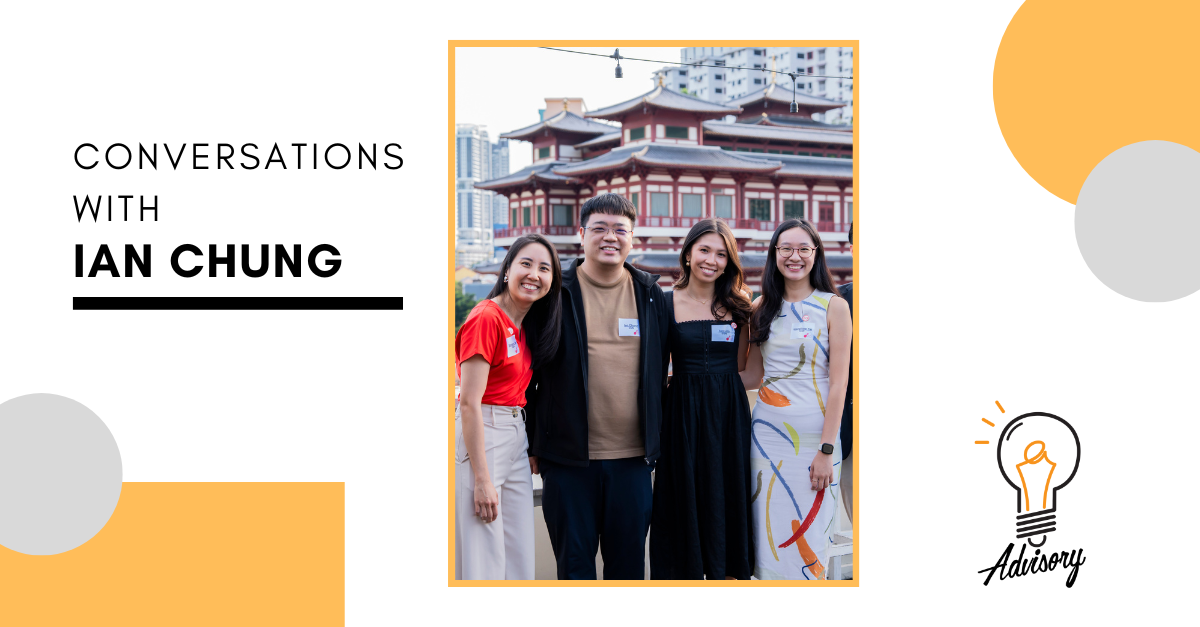
Ian Chung is Deputy Director, Programmes & Partnerships, Singapore Global Network (SGN). In his current role, he oversees programme development and management across the network, and meets with partners and stakeholders collaborating with SGN, along with other tasks to ensure the organisation runs smoothly. In this interview, Ian shares about the different roles he had undertaken throughout his time in the public service, along with the running of his online literary journal, Eunoia Review.
Please introduce yourself to the audience.
My name is Ian Chung and I work in the Economic Development Board in Singapore with a community building team called Singapore Global Network (SGN).
What has your career been like in the public service so far?
I have been in the public service for about 12 to 13 years and began as a teaching scholar teaching English Language and Literature at a school for two years, before moving to different agencies within the public service. After that, I was at the Ministry of Education (MOE) HQ for three years where I was in the Higher Education Group, looking at university sector policies and international relations.
With my scholarship bond ending, the decision was what to do next, whether returning to classroom teaching or moving elsewhere in the public service. My boss at the time was originally from the Civil Aviation Authority of Singapore (CAAS) and suggested I consider a role there to develop myself, even though I had no background experience in the aviation industry. I decided to take up the challenge and had been at CAAS for a year in a market development role when COVID hit. Like many of my CAAS colleagues, my next year was then spent working to keep the aviation sector afloat.
Coincidentally, a friend of mine was at the Smart Nation Digital Government Office (SNDGO), which is now part of the Ministry of Digital Development and Information (MDDI). They were building out their team that worked on longer-term research master planning for the Singapore Government, including as part of the National Research Foundation’s Research, Innovation and Enterprise 2025 (RIE2025) Plan. I joined them at SNDGO for a year and got to interact with researchers working in areas like artificial intelligence (AI), cybersecurity and quantum technologies.
After about a year, there was a change in direction for this team and it underwent some restructuring. An opportunity came up for me to join the National Arts Council, in the literary arts team that looked at ecosystem development for writers and publishers, where I spent another nearly three years, before moving to my current role with SGN.
Why did you continue to stay in the public sector?
I enjoyed my time at MOE HQ doing policy and ops work, and I was quite clear that this was what I wanted to do for the rest of my career, compared to classroom teaching. We typically spend a third of our time at work, so if we can find something that resonates with us and gives options for career mobility, I think we should seize that opportunity to do something meaningful.
More broadly though, I also think it is important that we have good people in both the public and private sectors to solve problems for Singapore. The Government will have its policy tools that only the Government is able to implement, so you need public officers willing to engage with these problems to find solutions, while also recognising that the private sector has its role to play.
Personally, being able to take a longer-term view appeals to me, knowing that the work outlives any individual officer, and plays a part in making Singapore better.
Were you able to find a role that was related to what you studied in the end?
Yes, when I joined NAC to work on ecosystem development for the literary arts.
The literary arts sector consists of two key stakeholder groups. First, the individual writers, and increasingly, literary translators. Writing by itself is a solitary activity and only becomes communal when the work gets read. Second, the publishers, which technically fall within the media industry.
Both groups tend to feel that more can be done to support them. A big part of my work was getting them to see what support had already been rolled out, but also getting people to understand that there are always tradeoffs to decisions. To give an example, it is realistically very difficult to make a living just from writing and selling books. This is true everywhere in the world now, because publishing is an industry, and publishers are businesses that need to make bets on what is commercially viable. However, a writer could potentially take up jobs in adjacent sectors such as film/TV scripting, or narrative design for video games, among others, which can provide a more stable form of employment. The tradeoff is the time they are then able to devote to their own creative practice. Some writers are willing to make the tradeoff, some are not.
How did you end up at Singapore Global Network?
After working at NAC for about three years, another friend of mine at SGN was looking to bring someone in to take over from an outgoing team lead. We had a chat about what the work would entail and whether it would be in line with my own professional aspirations. That was actually a quick decision for me, and what took more time was working out how to make the transition on NAC’s end as smooth as possible for the existing team.
What is Singapore Global Network?
You may have heard of an outfit called the Overseas Singaporean Unit (OSU). OSU was a team that looked at keeping overseas Singaporeans engaged, but also with the intent of persuading them to come home. It used to run events such as Singapore Day, which I was actually a beneficiary of as a student, since one edition was held in London when I was a student in the UK.
In 2019, SGN was formed from the restructuring of OSU, and given a broader mandate to build a global community with Singapore and our story at its core. We want to help people build connections that matter, whether their interest is in moving here to study or work, or just finding ways to contribute wherever they are in the world.
How is SGN beneficial to Singapore?
Singapore is a small country with limited natural resources and people have always been our greatest asset. This is not limited to the Singaporeans who have grown up here but encompasses the broader community of international friends who have moved here, contributed towards our economy and come to call Singapore their home. For the ones who eventually leave Singapore, we hope that they carry a positive experience with them and that they will tell the next wave of people out there who might then consider Singapore as part of their own journey. Similarly, our global community of Singaporeans working and living abroad also serve as an extension of our people networks, helping bridge connections, fostering community and flying the Singapore flag where they are at. Together with my SGN colleagues based in Singapore and abroad, we work hard to grow and engage our global network to harness the collective potential that it brings and help create opportunities for Singapore.
Fundamentally, we think of ourselves as managing a network whose members will need platforms through which to connect with each other, so that they can give back their collective skills and experiences to help each other and Singapore. This could be as simple as members helping to answer each other’s questions on things like relocation journeys, or even to the extent where our international friends of Singapore are sharing their experiences to help build the next generation of Singaporean professional leaders.
This helping each other can take place anywhere in the world. We have an initiative called Kakis Abroad, which pairs members looking to relocate overseas with experienced in-country buddies. Think of it as finding your first friend, who helps to smoothen your transition. Recently, we came across a case of a Singaporean living in the UK who had a landlord dispute, which they were able to resolve because their “SGN Kaki” was familiar with processes and could give the appropriate advice.
What are some tangible metrics that SGN uses to show that their initiatives are a success?
As a network manager, SGN looks at the size of our network, presently about 223,000 members, and the activity and interactions taking place within the network, e.g. through our SGN Community Platform. We think of this both in terms of partners being able to tap on members to contribute (e.g. their time, their skills) and members themselves being willing to avail themselves.
Since we also have an interest in sharing interesting things that members are doing, we feature stories of individual members on our social media channels and evaluate what kinds of storytelling resonate better with our different audiences.
What are some challenges that you have experienced in your role?
The biggest challenge for me is really finding enough time to engage with partners and stakeholders, especially when it sometimes feels like we have more potential partners hoping to work with us than the team can feasibly take on. A happy problem to have, since it means people out there are resonating with our mission.
The reality is that SGN is currently a team of about 50 people, including our colleagues based overseas. Between us, this team has to cover almost all the functions of running a small company, if that company’s core job is network management and engagement. All this for a network of 223,000 members and growing every day. So there is a lot of internal coordination needed to keep things running smoothly, while still making sure we continue to experiment with ways to better deliver a good member experience to the network.
I would say our main challenge collectively is consciously making time to take stock of our current efforts and to continue driving improvements and progress, as it is very easy to get caught up in the day-to-day tasks. So we do make it a point at the start and middle of the year to come together as a whole organisation to ask ourselves some of these questions and how the answers can inform our planning.
What is the most memorable thing that has happened in your work at SGN?
Every year, SGN runs a National Day campaign to support the engagement of overseas Singaporeans. In 2025, the theme was “60 Never Looked So Good”, since our nation was celebrating its 60th birthday. For this campaign, we approached Singaporeans in their 60s from different fields of work, and got them to do a professional photo shoot, contrasting high-fashion styling with old-school backdrops and props.
I think the whole experience of going down to the campaign shoot was quite memorable. Also, the underlying message we wanted to put across with “60 Never Looked So Good”, that as a country, we have been around for quite some time, but really we are just getting started and looking ahead to our future as a nation.
How do you spend your free time?
I am a big fan of theatre, so I attend plays whenever I can.
I also enjoy reading, in particular science fiction. I think as a genre, it is where writers have free rein to explore ideas and map out how they might impact humanity, in ways that have lessons for us living in the present moment.
What made you start Eunoia Review?
I started Eunoia Review when I was still in university. As a student in a creative writing programme, I was exposed to a lot of literary journals, so that was where I learnt how these journals worked. At some point, I figured I might as well try my hand at starting a journal myself. It has been about 15 years since, and I still run the entire journal alone, from proofreading entries to formatting it for the WordPress website.
Could you tell us how the name Eunoia Review came about?
I read a poetry collection of the same name by a Canadian poet called Christian Bök while I was in university. The concept of his collection, Eunoia, is that it has five sections where each section consists of poems that only use words containing a single vowel. I found that concept quite intriguing. On top of that, “eunoia” is the shortest word in the English language that contains all of the vowels, and one way of translating it is “beautiful thinking”. That, I felt, was what I wanted my journal’s contents to showcase, and that has been the name since. (And no, it was not named after the JC.)
What is the criteria for poems to be approved before it is published?
There are no strict criteria; rather, over the 15 years of running the journal, I have developed a sense for what I am interested in publishing as an editor, as well as what works I want my journal to be associated with. A friend once commented that if all humans vanished and aliens came to view our digital remains, whatever Eunoia Review contains would likely be one of the most comprehensive distillations of what one individual human was interested in reading. I quite like that thought.
How do you balance meeting the publishing demands of Eunoia Review and your daily work?
Despite Eunoia Review being a one-man show, I am able to squeeze in some work in the pockets of time I have throughout my day. For example, when I am commuting to the office, I will read some of the submissions that have come in and respond to them. In terms of proofreading, since I have already accepted the work, I am simply looking out for stray typos or grammar errors, which is not particularly taxing. In fact, I find it quite meditative.
I do not publish the works in issues, which is the way most magazines do. Instead, I publish daily, in the order entries come in. I schedule entries in advance as well, and keep about a week’s worth of posts (about 20-30) queued up, so the journal can still run for a few days without my intervention, say if I hit a crunch period at work.