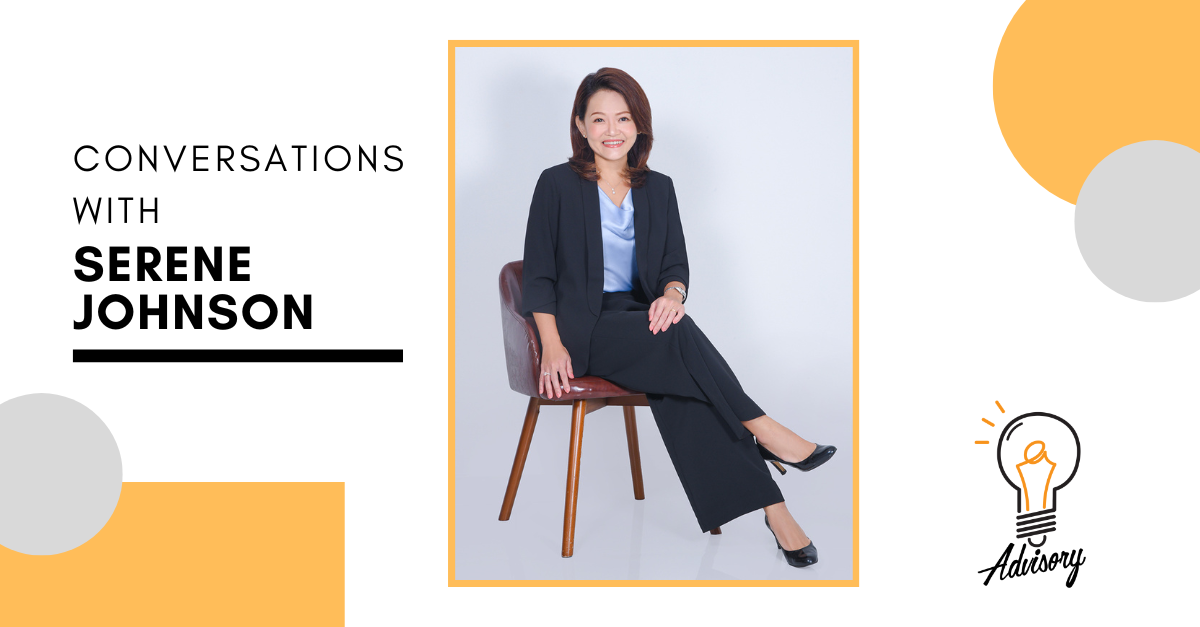
Conversations with Serene Johnson
By Caitlin Tan & Soong Hung Hao
Serene Johnson is Executive Director, AFCA (Asian Fuel Chemicals Association). In her current role, she leads the industry-funded nonprofit in advocating on behalf of member companies, engaging regulators and stakeholders across the region on fuel specifications, electrification trends, and urban air quality. In this interview, Serene shares about her career journey, from starting out at Shell's Pulau Bukom refinery, to an eight-year stint in the Netherlands, to leading strategy and energy transition work.
Could you tell us a bit more about yourself and what your everyday life looks like?
My work day involves meeting a lot of people. I work in advocacy - I run a trade association, so that means that I represent all the member companies that are providing funding to support research and stakeholder engagement.
To do my job well, I need to understand my external stakeholders really well. This involves asking questions like: what is the regulatory landscape, what are the latest developments when it comes to sustainability concerns, fuels, and gasoline specifications, what are the trends when it comes to electrification, how will geopolitics impact trade flows and policy priorities.
The only way to get that intelligence is to actually go and meet a lot of people. So I'm probably only in the office less than half the time, although I do like to spend face to face time with my team.
I travel quite a bit as well. Having face to face time, building trust and relationships is always very important. I often run into people at the airports in the region.
I also spend a lot of time doing volunteer work. I just came from the SMU women's alumni lunch because I’m the incoming chairperson. I do a lot of grassroots volunteering activities such as meet the people sessions, and I help to organisea lot of PA (People’s Association) events. Volunteer work grounds me with what Singapore's true societal challenges are, and it gives me energy. I feel like I learn from doing volunteer work, and that is always meaningful.
In my free time, I like to run and get in the sun!
How do you fit everything into your schedule, and manage your time?
I always visualise time in the old school way. You have a glass jar, onions and garlic. You fit in your onions first. What are your main things that you really need to get done? And then you fill it up with other things (smaller garlic cloves) that spice up your life.
I'm also not saying this is the right thing to do but I do sleep very little, actually. I get around 5 to 6 hours of sleep per night and I tend to survive with that quite well. But they are trade-offs.
I think having a very supportive partner is very important at home. My husband is super hands on with my daughter, Hannah. I'm also very blessed that Hannah is quite an easy child - she's quite manageable and there aren’t any real challenges with her.
When it comes to work, volunteering, and my other commitments, I have to set very clear boundaries and say no to things, because if you are not protective of your time, like, you lose the onions as well in your jar.
In all aspects of life, I focus on delegation. I always think - is this a piece of work that only I can do, or can I delegate this to someone else that would really benefit from actually going through that experience too? This forces me to focus on activities that are actually value adding, and also this gives space to the team to feel empowered to make their own decisions and own their projects. Thus, learning how not to micromanage is critical for time management. But it means you have to let go and some times accept things may not be done to your own standard and that’s ok.
Additionally, I harness a lot of AI now with my work. In the policy space, trying to compare for example 4 different countries and the fuel specifications on how they have would have taken me hours (previously) to go through all that data myself to make charts. Now, with AI, I can just put everything on to local LLM and have a nice summary for me to then make sense of the data, review and synthesise, and make recommendations and diagnosis. I've started to integrate a lot more AI into our workspace and encouraged my communications team leader to use AI for our newsletters and develop dashboards, so that we can reduce time spent on manual labour.
Adopting technology and process improvement is probably something that came from my experience in Shell because there, we were always just trying to see how we can do things better.
Do you enjoy the work at the trade association, seeing as it is so different from what you did before?
Firstly, AFCA is an industry funded nonprofit, not a charity. We advocate on our members behalf to create market demand for a particular fuel additive that they all produce.
As we all know, passenger road transport should be electrified as quickly as possible. We should put as many people as possible onto safe, reliable, affordable, public transport systems. And while we believe that we should do that, we also recognise that in some countries, electrification is gonna take more time.
Unlike Singapore where cars are expensive and consumers don’t bat an eyelid when buying a Tesla compared to other vehicles, in other countries, the situation is not the same. If you look at the gig economy in Jakarta, or Ho Chi Minh, where two or three families are relying on one two wheeler as their source of livelihood, they might find it unaffordable to electrify overnight. Additionally, there are other problems such as public transport infrastructure and air pollution.
In other words, decarbonisation will definitely come but in the meantime, there are challenges, and it's about doing what we can to cope with these challenges and improve urban air quality at the same time.
When talking about the use of gasoline, we have to be clear about the goals we have. Trying to solve a lot of problems at once is almost impossible, and what I like about the work at the association is that I have a very distinct and clear mandate - to make a visible impact by just focusing on urban air quality. This clear scope is much more satisfying than boiling the ocean and trying to solve a problem in many different ways.
This clearly defined as a scope allows me a lot of autonomy to drive and help my members and make tangible impact. That makes a lot of sense, like, being able to really see exactly what you're doing, rather than just reaching everywhere.
Have you always been passionate about the climate or like where exactly did you get this passion from?
From 2007-2014, I was based 8 years in Amsterdam, in the Netherlands, with Shell. And towards the end of those last eight years, I worked on a business that produced styrofoam. A lot of cushions, mattresses, are all made from these materials.
These polymers cannot be recycled. So you can imagine mattresses being tossed onto the streets that have no second life. This made me feel really bad about the industry and how we need to improve. We worked with companies like IKEA, and looked at how we can make more sustainable mattresses. Instead of using the entire piece of foam to make the mattress, we mixed recyclable materials into the foam. This is really what we call having circularity in mind when designing a product.
This mindset pushed me into understanding sustainability more. In the chemicals and energy industry, there is a very singular measure of sustainability and that is carbon.
But when I was nominated to the WBCSD’s Sustainability Leadership programme, (world business council for sustainable development), and talked to a whole network of sustainability practitioners, I realised that there were actually a lot of different aspects of sustainability. For example, good supply chains, clean water, hygiene and sanitation, basic human rights, gender equality and access to education. The 17 UN sustainable development goals!
There are broader sustainability considerations, and when my career really moved towards sustainability, I started thinking about how sustainability needs to become the core of our business, and not just something we measure to satisfy stakeholders.
Earlier, you mentioned that you spent some time in the Netherlands as part of your Shell career. How was that experience for you?
There were three eras of my shell career. I started as an SMU finance economics grad, not a chemical engineer. But they put me into the refinery in Pulau Bukom, and I started my first job in Pulau Bukom. It was interesting - I had to take a ferry to work every morning.
My career in Shell actually started in quite a technical setting. I was breathing in a refinery , and walking through the furnaces, and really understanding what it's like to be in a petrochemical setup. Learning how to work with colleagues who are much older, from technical backgrounds was growth for me.
After two and a half years of that, I got a job offer from Proctor and Gamble (“P&G”) to be a manager for cosmetics packaging.
So I went to talk to the senior general manager at that time that was running the project, and told them that I wanted to quit because I got this really interesting offer from P&G to make bottle caps. The general manager looked at me like I was mad, and offered to send me to the Netherlands for an overseas experience program for graduates. So that’s actually how the conversation came about.
If PnG didn't give me an offer, I don't think I would have gotten a counter offer from Shell to go over to Holland.
What did you learn while in the Netherlands?
At that time, I was 25 years old and I was having the time of my life. I learnt more about being independent - cooking, cleaning and ironing. I learnt how to set my own priorities. I got the opportunity to pick my own apartment, meet new people, learn a new language. I even picked up Dutch and I still speak Dutch to my old colleagues.
What was the working culture in the Netherlands like?
The Dutch culture is very similar to Singapore and that we are very pragmatic and very straightforward. It’s a low context culture. What you see is what you get with a Dutch.
I had to learn to speak up in the work environment in the Netherlands, because they often disagree for the sake of improving a decision’s quality. That was new to me back then, as we operated differently in Singapore previously. We tend not to be too confrontational. To really speak up for myself required adjustment.
Another trait I developed was the dexterity of switching your working styles depending on the kind of project, the kind of role that you do, and then the kind of people that you're working with. This brings me to my point about working with different people.
Diversity and inclusion was a real eye opener for me. Now, it is common to hear questions like “what are your pronouns”, “what are your orientations”, but back then in 2007, the Netherlands was advanced enough to have such a very inclusive environment. The work culture was very progressive and even things like sabbaticals (which were not common in Singapore) back then were common there.
I took a lot of that back with me because when I came back to Singapore my mindset was about how I can bring out the best in everyone, and this includes not assuming what everyone's personal life context is. How do we ensure that we create an environment that everyone's got the psychological safety to contribute? Similarly, how can we collaborate better and how do we listen to different stakeholders and bring their values and perspectives into the decision making process? That is really important to build lasting relationships with people.
What was your role at Shell in Singapore (after the move to the Netherlands)?
I was doing a lot of sales and marketing for a lot of different types of chemical products. Then I actually went into the inhouse strategy team. There, we were thinking about the type of projects we should do, and answering questions like what and how and where we should grow. We asked questions like what technology we should be using.
This role was quite technical in nature, which was another learning experience.
Coming from a business account, finance background, I learnt that I have to know enough about the technologies to ask the right questions in order to gain the respect from the team and add value to the strategy of what I was doing.
So, when I came back from the Netherlands, I continued doing a strategy role and started working on climate and energy transition.
What’s your tip for working across different cultures?
I really believe in speaking the language of your audience - be it Chinese, Dutch or whatever. AI can do most of the work for us, but if you want to speak from the heart and build relationships, language is really important.
I personally found that because of my language ability, when I went to China to help with the joint venture project, the joint venture partners and representatives were very happy to open up to me. They shared with me who they liked, who they didn't like, and the ‘gossip’. They would say the real reason why something didn't get done or the real reason why a person got his job. That rapport and understanding gleaned helps to get a deal across the mind. This is because you get to know more of the context from conversing with these people.
What are some of the soft skills or communication skills you find helpful at every job?
Sometimes Singaporeans think through a very transactional lens. For instance, this project makes sense, it’s the best, it makes the counterparties a lot of money, and they fail to understand why the counterparty does not want to do it.
This is where communication skills come in handy, and cannot be replaced by AI. You need to learn how to read the room, build the relationship and build trust with stakeholders. This is important so that people will open up and tell you the real underlying reasons why some things are not done or are slowed down.
These are life skills which you will hone and continually practice as you go through these life experiences. As an example, the way I communicate with a leader - like a CEO, and someone like a janitor - would be different.
I believe that when you reach a level in your career where you're managing a whole spectrum of people, you need to be able to have different communication styles to understand and be understood.
What are some characteristics of good leadership to you?
I think a good leader is somebody that protects. They protect the people they are leading them from distractions or unreasonable demands from stakeholders. Good leaders should trust you, and there should be psychological safety for people who the leaders are responsible for to come to the leaders when there is a lack of clarity or disagreement.
A principle which is important and that I encourage is that just because I'm your boss right now does not mean I know everything better than you. There are aspects that I, as a leader, want to learn from you.
Great leaders who have that humility and that trust with their team really allow people to fulfil their potential and challenge. At the end of the day, having good leadership also leads to a higher level of decision quality.
Any career advice for young grads?
I think it's very easy to allow an organisation to chart a path for you. And once you’re on a particular career pathway, it’s easy to follow it and achieve the milestones that are there to achieve.
But what is always important to me is not necessarily the titles (like making VP) for example, I really want to do things that make me feel excited and make my brain feel like it's being used. I want to learn new things, so I really chose the topic of energy transition and sustainability which excites me.
It is so important to not just tick the boxes that people set out for you, but rather, be true to yourself and be self aware of what motivates you and what makes you happy. These are things you can find out even in school - in school, you have that space to find out if you like field work, for example, or meeting people, or doing research, or writing papers.
Everyone has their strengths.
Of course, there are certain caveats to this - essential life skills like basic communication that you have to know regardless. But working for someone that sees the unique value that you're bringing will give you that boost in the morning when you will wake up, and motivate you to bend over backwards to create good work.
How did your education contribute to where you are today?
I think education is teaching you how to learn. It gives you the muscle to analyse things, develop self-discipline, delayed gratification and teamwork.
So, for context, I am from the pioneer class of SMU, and the reason why I chose that back then was because it offered a seminar style of learning that fully engaged students for each class, with an emphasis on class participation. It felt very different and I liked it.
As the first batch of students in SMU, the cohort was extremely entrepreneurial - starting up societies, sourcing good food when the canteen food was bad. That was a great takeaway for me.
But beyond the technical aspects of learning, I would say value the time you spend with your classmates, and your cohort, and your lecturers. Today, not only is being booksmart important, it is important to be street smart and have good emotional intelligence. It would be good to really work well with people because that makes the most difference.
Beyond your education at SMU, you did quite a few executive courses after graduation as well. How was the experience, and do you recommend it?
For sure. Learning to learn is a muscle, and just like training muscles for a marathon, you also have to train the muscle to learn. The moment you stop learning, you become complacent, and lose your humility because you think you know everything.
Having that continuous hunger for upskilling yourself is so crucial.
Another way that executive education benefits you is the network. When I went to the WBCSD sustainability program, I had colleagues from Unilever, PNG, mining companies, Deloitte and a broad range of different industries and practices. This is helpful, because for instance, when I need someone to teach me about fertilisers, I have someone to call.
In a similar vein, when I did the Singapore Institute of Directors program, I was able to bring my knowledge and experience working in an MNC, and contextualise that into what my job would be if I was on a board for a listed company for instance. Knowing the obligations, the legalities, the judiciary duties, the financial exposures and implications are incredibly important.
Going back to school is good in another way, because you get to learn the tools that students use to learn. For instance, I picked up AI when I went back to school from one of my course mates.
Do you have any advice for students reading this article who are inspired by your story?
A lot of things come down to whether you are able to strike a deal. This is because every decision, ultimately, is gonna be a compromise and negotiation. So it’s important to make sure that you get your point across in an effective way, understand each other's perspectives, so that everyone can move on with a happy compromise.
Making friends is important because it allows you to build lasting professional relationships. A friend in need is a friend indeed in the business world. Focus on building trust and credibility because that goes a long way.
One of the reasons why I landed this role is because my CV, through a headhunter, ended up on the desk of my ex boss. When he picked up my CV, I’m sure he thought of the me that worked for him 15 years ago.
So, always think about what impression you are leaving someone with, even if it is a small interaction. So that's why every interaction and every opportunity needs to be so deliberate, and the best way of being delivered is being genuine and being caring.
Sincerely caring about people and really caring about how you show up, your experience, and what you want to give to people, is something that is always good. If you build up trust and a good reputation, that reputation will follow you everywhere you go.
Relationships matter, and this is something not emphasized enough in schools. In Shell, they measure talent by capacity, achievements, and relationships. C A R. Capacity is about how strategically you are and how intellectual you are. Achievement is how you do work - how you run projects, how you get timelines, milestones, how driven you are. Achievement is actually getting things across the line and deliver impact/outcomes.
Relationships are really about how you interact with people. It’s important to recognise how you show up in a 360 manner, and how you treat every single stakeholder. How you treat people reflects heavily on you. You never know whether someone you treat badly might be someone who will help you in the future. This is especially true in the context of Singapore, and in the context of the world which is getting so small and so connected. Treat everyone nicely and with respect.