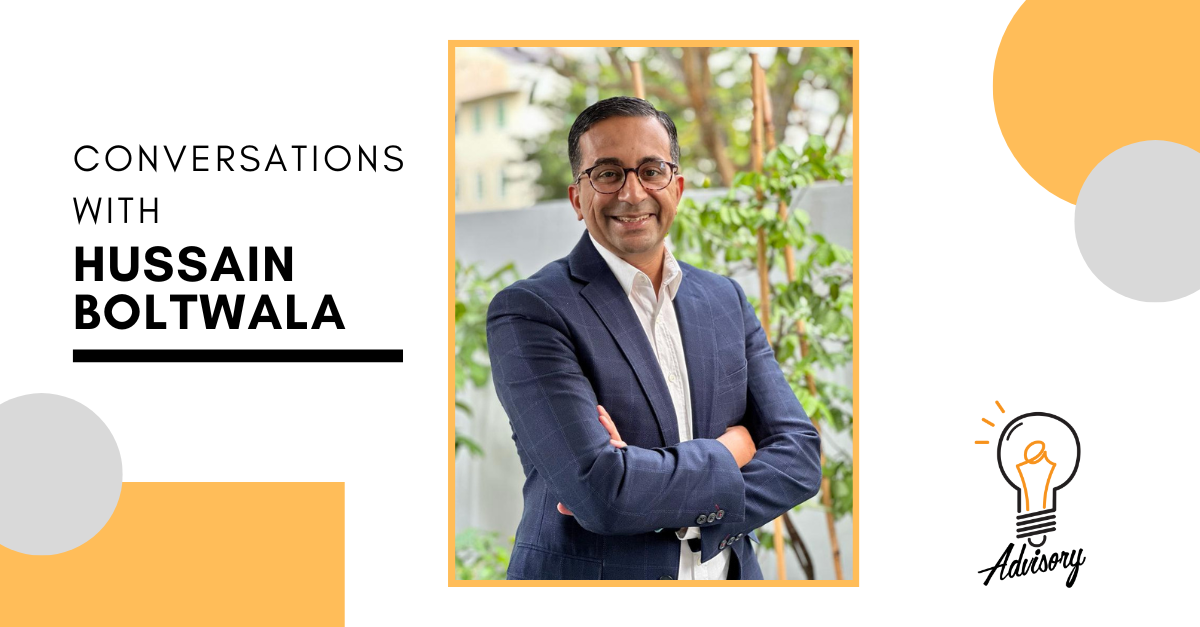
Conversations with Hussain Boltwala
By Damon Chee and Tan Beng Yang
Hussain Boltwala is a Presales (Solutions Architecture) Leader at MongoDB. In this role, he manages a team of technical experts (Solution Architects) to drive pre-sales strategy, consulting excellence and value alignment for complex enterprise data & AI solutions with the GTM team. His work takes him across different countries in the Asia Pacific region. In this article, he shares how companies have benefited from using MongoDB, why he chose this line of work and the importance of a growth mindset.
Please introduce yourself to the audience.
I am Hussain Boltwala, a pre-sales leader at MongoDB, a technology company that provides NoSQL document database platform. This is my second year at MongoDB and in my current role, I oversee Indonesia, Malaysia, Vietnam and the Philippines. Before that, I spent almost seven years with a CX software company called Medallia.
I have been in Singapore for about six years, moving from Australia just before COVID hit, and it has been my home since. My career has spanned across four different countries and seven different cities. This has allowed me to travel and experience a lot of different cultures and regions. My professional experience spans infrastructure, consulting, customer experience, data analytics, machine learning (ML) and artificial intelligence (AI).
What does MongoDB do?
MongoDB is a database technology company that powers some of the most well-known apps and digital experiences. A database is where all information gets stored.
To illustrate the importance of a database, think about ordering food from an e-commerce application. The process from when and where your food was ordered, to the point of delivery, driver details and all other details need to be kept and stored. Whenever you refresh your app, your app fetches all these details from the database.
MongoDB is a special database which does not store data in rows and columns, but keeps them in the JSON (JavaScript Object Notation) format. JSON uses human-readable text to store and transmit data, allowing developers to access data and write code in the way they are familiar with.
MongoDB can also store structured data such as text and numbers, unstructured data such as files, documents, audio and videos, and in a vector format to power AI usecases. Vectors is the format in which documents, images, audio and video get stored in a numerical format to be understood by Machine Learning and AI applications.
Lastly, MongoDB Atlas is a fully managed cloud database service offered by MongoDB that simplifies deploying, managing, and scaling MongoDB databases across multiple cloud providers like AWS, Google Cloud, and Azure. It automates infrastructure provisioning, setup, backups, patching, scaling, and security, letting developers focus on building applications rather than managing database operations.
What is the job scope of your role at MongoDB?
I manage a team of technical experts (called Solutions Architects) who work with the sales and other go-to-market teams to position and secure the ‘technical win’ with our customers.
We have to take the time to truly understand our customer’s needs, what pain they have with their current database solution and design a solution that solves these challenges for our customers.
On a typical day, my team will run discovery workshops with customers to understand their technical and business requirements, as well as run demos to position MongoDB’s features and capabilities. We also participate in industry and company events to support our marketing efforts. My team will also do skills and training workshops with the developer communities to help them gain MongoDB skills, certifications and go deep into best practices.
My job, ultimately, is to empower my team to do their best work and deliver an outstanding experience for our customers. and serves our customers so that they have the best possible experience with MongoDB. In this way, the business achieves its go-to-market objectives.
How have companies benefitted from using MongoDB?
There are so many great stories of companies benefiting from adopting MongoDB!
AI is making a huge impact in the field of molecular research & drug discovery - something that has traditionally been quite slow and expensive. One of our biotech customers custom trained an open source model using their proprietary clinical research and operational data to predict the properties of substances, reactions and even discover entirely new molecules by leveraging MongoDB’s vector search features. They can now accelerate the discovery of substances, development of new molecules and drive significant improvement (almost 50%) in pharmaceutical discovery and drug manufacturing.
Various banks in ASEAN use MongoDB to store transaction information and device attributes to detect fraud using AI driven similarity search and suspicious pattern matching in real time. This also means that these data science teams can deploy country specific, contextually relevant models that move away from a pure rules based model to an AI driven model that continuously improves over time to fight financial crime.
In Singapore, Circles optimized their server costs, simplified regulatory compliance and empowered their engineering teams to move fast to launch new offerings. For example, they launched Jetpac - their travel and lifestyle offering in just six weeks to meet the year-end travel demand post Covid. Revenue grew by 500% and Jetpac is now available in more than 200 countries.
MongoDB Atlas’ automation, flexible data design and AI-ready features – especially vector search for RAG (Retrieval Augmented Generation) – have been key to Circles’ ongoing innovation and ability to deliver seamless experiences to their users worldwide.
What are some trends you see in your industry?
These last few years have been extremely interesting in tech - with both advancements and challenges. The speed at which AI has taken over has been rather intimidating. There is a fear of job losses due to large productivity gains and we will all have to navigate this uncertainty.
It started with RAG, which retrieves data from internal and external systems and feeds it into LLMs (Large Language Models, like ChatGPT) to generate and infer responses, with varying degree of accuracy.
Now, Agentic AI has become a big focus, which can accomplish complex multi-step tasks and make decisions with minimal human supervision.
Productivity acceleration has already occurred at various levels, where things that were taking weeks or months to do will now happen within days. Everyone should learn how to use AI tools to be more productive in their jobs. However, we just need to apply a layer of checks and controls to ensure what AI is giving back is accurate & rooted in reality.
With such large investments in chip production, data centres and electricity generation, companies are in an arms-race which will only further accelerate innovation in making systems faster and more accurate.
Also, I feel that whilst the larger AI companies will continue to incrementally differentiate and build better and more accurate models, there could be consolidation within the smaller players over time. Ultimately, there would be specialisation, with AI companies developing special capabilities to serve specific use cases and industry segments.
How has AI affected MongoDB?
AI has been great for our business and we have seen a big surge in demand for our products and services.
When companies think about AI, they need a platform like MongoDB to work with a variety of unstructured data formats and modernise their legacy systems.
MongoDB provides a high performance and scalable foundational data storage layer for any application. With its rich AI native capabilities such as semantic text and vector search, along with an ability to integrate with most AI and machine learning frameworks, this makes it the ideal choice for AI applications.
What made you choose this line of work?
I graduated with a degree in Telecommunications & Internet Technologies around the time when the internet was taking off.
You could say that I got into this industry due to my degree. However, I also realised early on that I liked the business aspect, meeting with customers and designing solutions, so I always tried to be in customer-facing roles. Pre-sales is a great mix of technical skillset and customer and business facing experience.
So I can’t say I chose the path as sometimes the path chose me, and I tried to make the best of those opportunities. The rest was due to curiosity and fate. My career has spanned various industries like infrastructure, consulting, customer experience, data analytics and now databases & AI.
I have had the good fortune of travelling, working and living in various countries and regions and I feel very fortunate to have had these experiences, all due to my line of work.
Of the cities that you have worked in, which one stood out to you the most?
This is a difficult question. Australia offers a wonderful lifestyle, open spaces, and beautiful natural landscapes. However, I believe Singapore is one of the best places to live — it’s safe, family-friendly, and strategically located at the heart of the Asia Pacific region.
Given my Indian heritage and my wife’s Singaporean roots, the decision to move from Sydney to Singapore felt completely natural - so when the opportunity arose, it was an easy choice for both of us.
Professionally, Singapore serves as a gateway to the broader Asia Pacific market. Many global technology companies have their regional headquarters here, overseeing markets across ASEAN, Japan, Korea, China, Hong Kong, and Taiwan.
This provides the opportunity to work in a much larger and more diverse market. The region is highly heterogeneous, with distinct cultures, languages, and business environments in each country — making it both a challenging and rewarding space to operate in.
Why do companies operate from Singapore when they can set themselves up elsewhere in the region?
Singapore provides an exceptional environment for business. It offers remarkable ease of doing business — from setting up entities to accessing a skilled and talented workforce. The presence of world-class universities and the country’s openness to foreign talent ensures that labour needs can be effectively met, even in specialised areas.
Another key strength is Singapore’s strong intellectual property protection framework, which stands out compared to many other countries in the region. In addition, the country’s well-regarded court of arbitration provides efficient mechanisms for dispute resolution. Finally, Singapore’s effective and transparent tax system further enhances its appeal.
These factors make Singapore an exceptionally great environment for commercial entities to do business here.
On your stint in the Middle East, how was it like to work there?
I moved from Australia to Dubai to set up the Middle East operations for Argent Software, an observability company I worked for in 2007. Every country has their cultural nuances and in the Middle East, it is very relationship-based. By being based in Dubai, I had access to other markets in the Arab region such as Qatar, Saudi Arabia, Oman, et cetera. Although there are slight cultural nuances between the different Arab countries, overall, the region is generally homogenous.
It is also a region with a very different physical landscape and weather, which is probably the biggest adjustment one would have to make when they move from a country like Australia. In Dubai, it gets scorching hot by 10AM in the morning in the summer months from around April to September.
Humans are adaptable and people figure things out to make it work. Singapore is a very humid country and the solution is to turn on the air conditioner. I did the same in Dubai as well.
Moving to a new place, you just have to figure things out and push yourself to get out of your comfort zone and adapt. This mindset has also helped me personally and professionally - life is never a linear path and you have to figure things out and adjust accordingly.
Throughout your life, is there anyone that you have looked up to which changed you as a person?
I feel, no single person can drastically change your thinking or life path. Instead, I follow many people and try to view things from a variety of perspectives.
I read widely on technology, geopolitics, psychology and self-help. One impactful book is Mindset: The New Psychology of Success by Carol Dweck. I recommend it to those early in their careers, as it clearly illustrates what a growth mindset is and how to embrace it. The book teaches resilience in setbacks and how to use feedback constructively to learn, grow, and move forward - both personally and professionally.
What advice would you give to people who want to go into your line of work?
One major change from when I graduated is that nowadays, most people experiment with their professional choices and don’t necessarily go into the profession that they graduated in.
You have to be adaptable in terms of skillsets, mindsets, roles and responsibilities. People have to constantly be learning and upgrading themselves and be genuinely curious about various things that are happening in the world. Be hands-on, especially with technology and get your hands dirty by trying things out and experimenting with ideas and approaches.
Learning does not have to be in a very formal classroom environment. One can use online resources or those provided by various companies - it has never been easier to learn new things.
Lastly, developing a growth mindset is essential. Setbacks are part of life, and challenges in your path may require you to pivot and reassess what makes sense for you. Be resilient, recognize your limitations, embrace critical feedback, adapt, and move forward.
Do you have any final comments?
Advisory is an outstanding platform and it’s inspiring to see volunteer youth like yourselves contribute to the community with such dedication and effort. I encourage everyone who reads this to give back as well.
Throughout my career, I have benefited from the support of many people and Advisory provides a meaningful way to do the same for young Singaporeans. By sharing our experiences — both successes and failures — we help them gain a head start and avoid common pitfalls, enabling their growth and development.