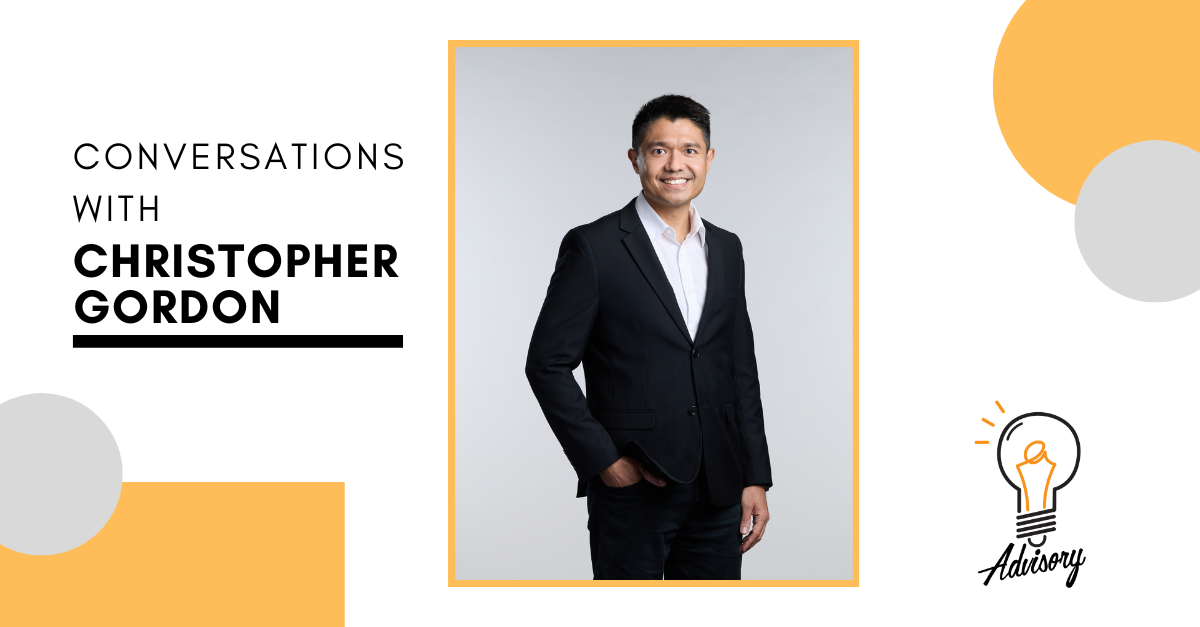
Conversations with Christopher Gordon
By Damon Chee and Eve Ong
Christopher Gordon is Director, People Development, at the National Council of Social Service (NCSS), where he leads a team driving manpower programmes and volunteer management capability building for the social service sector. In this interview, he shares with us his motivations for working in the public service, the skills he has picked in his various stints, and the lessons he learnt throughout his time there.
To start off, could you tell us more about yourself?
I am Christopher Gordon, Director of People Development at NCSS. Prior to my role at NCSS, I have worked at different portfolios across the public service, such as the Ministry of Foreign Affairs (MFA), Ministry of Manpower, (MOM), the Prime Minister’s Office (PMO), Ministry of Digital Development and Information (MDDI), and the People’s Association (PA).
Did you foresee yourself working in the public sector after A Levels?
It was one of the choices that ranked highly in my mind. I pursued triple science as a subject combination during my A Levels as students were allowed to do so then, and it was a popular route to enter medical school.
I also considered working as a researcher for the Agency for Science, Technology and Research (A*STAR) as I was involved in a science research project with the Tropical Marine Science Institute at the National University of Singapore (NUS) while in Junior College. I subsequently applied for the A*STAR Research Scholarship where a student's education up to a PhD would be funded while they concurrently worked at one of A*STAR's research labs.
Another option was to work in the public sector as I found the mission of the public service meaningful, allowing me to contribute to building a stronger and socially resilient society for Singapore.
In all, I applied to Medicine at NUS, the A*STAR PhD scholarship, and the Public Service Commission (PSC) scholarship tied to MFA, and was successful in all three applications.
What was the key consideration before committing to an offer?
My key consideration was the job that I would take up with after my studies. I weighed between joining the foreign service as a diplomat versus a researcher at A*STAR, versus a medical doctor. What appealed to me most was the opportunity to serve as a diplomat — the opportunity to travel overseas to represent Singapore and advance its political and economic goals. Therefore, I decided to accept the PSC Overseas Merit Scholarship, thus beginning my career at MFA.
Also, as part of the career development as a PSC scholar, it offers you an opportunity to rotate to other ministries and agencies to take on roles such as policy work.
What qualifications are necessary for someone who wants to enter the public service?
In the public service, there are a mix of generalist and specialist roles.
Specialist roles are more niche and require officers to have a certain training and background. For example, the Ministry of Trade and Industry has the Economist Scheme where their job scope includes looking at longer-term economic trends and conducting economic projections, etc. You therefore need people who are trained in economics and associated disciplines to do this role.
To work in generalist roles, officers can come from many different backgrounds. During my undergraduate studies, I read Aerospace Engineering at Cambridge before commencing my career at MFA. Officers do not need to have a background in political science to work in the foreign service. When I signed the MFA scholarship, the MFA staff were happy that I was reading engineering as they wanted their officers to come from a variety of academic disciplines and backgrounds. They feel that this would be beneficial to the organisation as it value-adds to the thinking and robustness of discussion as these officers may approach problems with different viewpoints and come up with varied solutions. After my stint with MFA, I worked at MOM, involving myself in continuing education and training policies such as skills upgrading and employment facilitation.
Therefore, these policy roles typically do not require people with very specific degrees or skill sets. Instead, what they need is someone with a good analytical mind; coupled with strong commitment to public service.
How did the pivot from MFA to communications and engagement roles come about?
As part of the career development process for officers who take on the PSC Scholarship or the Public Sector Leadership Programme (PSLP), they are rotated out of different ministries to different roles. This broadens the officers’ thinking, stretches them in a different area outside their comfort zone and helps them find clarity on where they can best bring value to the service in the long term.
I had the opportunity to move to MOM to work on continuing education and training policies after my stint at MFA. After the MOM stint, there was a choice to return to MFA. However, I chose not to due to family considerations, and decided to continue with MOM instead.
Then, the opportunity to pivot to communications and engagement came quite out of the blue when a new Communications Group was being set up at the PMO. This team would look at and strengthen last-mile communications and stakeholder engagement with different segments of society, including youth. Engaging with youth, understanding their challenges, but also effectively communicating with them, and distilling government policies in a way that is easier for them to understand were areas I am passionate about. This led to my move to the PMO Communications Group.
Incidentally, at around the same time, in my personal capacity, I was an active youth leader in various community organisations, including serving as Chairperson of the Eurasian Association Youth Committee and Council Member on the National Youth Council. These experiences helped enrich my understanding of the youth sector and enabled me to serve better and value-add in the PMO Communications Group, in terms of coming up with strategies to improve outreach and engagement with youth.
I developed my interest in government communications and engagement during my time at the PMO Communications Group. After two stints there, I moved to MDDI where I worked on media engagement and whole-of-government strategic messaging.
What is your most challenging role in public service so far?
It would be MFA as it was my first-ever job. The nature of the job also requires you to be prepared for anything and everything. In the MFA headquarters, we often have to staff our political officeholders, including the most senior leaders, and support them on their overseas visits or visits by foreign leaders. While you are not expected to know everything, you are expected to react quickly to unexpected situations.
This is made more challenging when you are overseas as Singapore missions are known to be very streamlined with small teams working under our Ambassador or Head of Mission. I had the privilege to work with Ambassador Simon Wong at the Singapore Embassy in Hanoi for two years. It was quite an exciting time with Vietnam serving as the Chair of ASEAN and we had a lot of our ministers visiting the city. You learn so much from the experience — how to be adaptive, independent, focused on delivering outcomes and making things happen, leveraging people in your network for support, and troubleshooting issues that arise.
The other role where I learned a lot was in MDDI, where I took on the role of Acting Director of Messaging and Engagement. It was challenging for two reasons.
One, it was my first Director role, having previously been in middle management as an Assistant Director and Deputy Director. As a Director, you run a whole department where you are not only responsible for managing day-to-day issues, but also the department's budget and the career development of the officers under you.
Two, I was not trained in communications or media, unlike the majority of officers in the Information Service. As someone from outside that space, I had to learn on the job and find ways to leverage my past experiences to bring value to my team of officers, who were all communications and media specialists.
What does People Development at NCSS entail?
My team in People Development focuses on manpower development and building volunteer management capabilities for the social service sector. These two aspects are important as we need passionate and dedicated professionals and volunteers for the sector to operate effectively.
My manpower team runs manpower development initiatives and programmes to ensure we can continue attracting good talent into the sector. Some examples include the Sun Ray Scheme to bring in corporate leaders into the sector, the 40-Under-40 programme to develop high-potential leaders in the sector, and the Social Service Scholarships to bring onboard professionals such as social workers, therapists and clinical psychologists. The team also looks at human capital best practices to uplift the sector, such as the sector Employee Engagement Survey (EES), sector salary guidelines and building Human Resource and Organisational Development Communities of Practice.
Other than developing the professionals, another integral part of our work is developing the volunteer management capabilities in the sector, so that social service agencies are able to attract and retain a pool of volunteers who help supplement the work professionals do. The volunteer management team at NCSS does not directly manage volunteers. Instead, we work closely with the volunteer managers in social service agencies — who engage, onboard, and retain volunteers on a day-to-day basis — to uplift volunteer management capabilities.
As Director of People Development at NCSS, could you walk us through how a typical day looks like for you?
A large part of my day is spent meeting with stakeholders in the sector. It includes engagements with some of our Sun Rays and sector leaders, our 40-Under-40 alumni, and stakeholders who help advance our volunteer management capabilities. Sometimes, we brief them on updates to the various schemes, host small focus group discussions to get feedback, or meet with them individually to understand their insights on the sector.
Beyond that, there are many corporate meetings: with NCSS Board or senior management to discuss the key issues affecting the social service sector, our parent ministry, the Ministry of Social and Family Development on policy and operational matters, and with other agencies we work closely with. They include the Ministry of Culture Community and Youth and the National Volunteer and Philanthropy Centre who are key partners in volunteer management and corporate volunteerism, the Workforce Singapore (WSG) on career conversion programmes for social workers, or representatives from our IHLs. The IHLs include NUS, the Singapore University of Social Sciences and the Institute of Technical Education where many of our social service professionals graduate from.
I also spend a significant amount of time in internal discussions with my team members to review the progress of projects, align on management direction, discuss new ideas or work through the specifics of initiatives we are driving.
What skill sets are needed to thrive in this role?
Interestingly, the NCSS People Development role leverages the different skills I have built from past experiences across the public service.
Firstly, the policy planning and analysis skills picked up during my stint in MOM are very useful when reviewing our sector manpower trends, designing and implementing our manpower programmes for the sector.
Secondly, the engagement skills I built at the PMO Communications Group and the People’s Association — skills I have to leverage on when organising engagements with social service sector professionals.
Thirdly, the communications and messaging skills I learned in MDDI are extremely useful when working on public campaigns for the sector such as Social Service Tribe movement, a campaign to profile professionals and volunteers in the sector.
Finally, the partnerships building skills I built up as a long-time volunteer in community organisations — skills which are extremely important to foster and grow the partnerships to support our volunteer management capability building work.
This role is not purely policy, operational policy, engagement, communications or partnerships building — it is a nice combination of all these. I often encourage youths not to see their internships and work experiences in a disparate or siloed way, but to realise that the holistic portfolio of skills, knowledge and experiences they build up in different roles over time may serve them well when they progress and take on new roles in the future.
What are your proudest achievements in NCSS so far?
I will caveat that I have only been in NCSS for eight to nine months. However, what I think is very exciting is that I am blessed to work with bosses, peers, and team members who are very encouraging and supportive of exploring new ideas.
One of these ideas is to take our signature 40-Under-40 programme for high-potential leaders the next bound by building the 40-Under-40 Collective. The Collective is a platform for programme alumni to collaborate together and create positive change to transform the wider social service ecosystem e.g. driving integration efforts between the healthcare and the social service ecosystems — embracing the spirit of “by sector, for sector”. Such efforts to support social-health integration will become increasingly important in the future when Singapore becomes a super-aged society.
How do you stay motivated as public servants often work on problems where results take years or even decades to become visible?
I want to stress to the young people considering a career in public service that very often, the changes you want to make don’t come overnight; some may take a few years or even decades to materialise. In the Singapore public service, we are always mindful that we work in a system that doesn’t think short-term e.g. one election cycle. This is a Government that thinks ahead and builds for the longer term e.g. for the next generation and the ones after. We are also mindful that our policies exist on a time continuum — they cannot be disconnected from the past nor the future. We build on the hard work and past efforts of our predecessors, evolve our policies and programmes to remain relevant and keep pace with the times and importantly, take these policies and programmes to the next level. This is to better serve the needs of Singaporeans in this generation and the ones after.
Sometimes, when policies take a long time to come to fruition e.g. years or even a decade, it can sometimes feel disheartening when we cannot see where all the hard work is leading to. It is not just yourself who might feel disappointed, but your team members as well. I believe it is extremely important for leaders to help keep their team members motivated; we need to help break down a longer-term policy change or initiative into more bite-sized “small wins” so that our team members can see the increments and the steady progress that is being made. This is something which I try to do for my team as well; to keep them motivated and energised. Sometimes, this is achieved by having your team work on projects which are more bite-sized e.g. a proof of concept or smaller phases of a bigger idea. This allows them to tangibly see and feel the progress of their efforts; and assure them that their efforts are eventually leading to something bigger.
How has your approach to working with and leading people changed from when you first entered public service to now?
The way I work with and lead others has definitely changed compared to when I was doing a middle management role in 2012 to 2019. Over the past six years (2020 – 2026), I have progressed to a Director role leading larger teams. I learned to appreciate over time that instead of functionally looking at officers in their specific job role and how they perform on their work tasks, it is often more helpful to take a step back and understand and appreciate each team member holistically; each officer has their own unique combination of passion, knowledge, skills and experience.
When we are able to effectively understand each team member’s unique complement of skills, knowledge and experience, we then realise that we have a multi-skilled, multi-experienced, and multi-talented team. We can achieve so much more when we can unlock the full potential of every member in the team and when every one of them is shining to the best of their abilities.
Is there anything you wish someone had told you before you stepped into public service?
First and foremost, for those who choose a career in public service, it must be about mission, purpose and service to Singaporeans — that is why it is called public service. Without a commitment to the mission of making life better for Singaporeans, it becomes challenging to sustain one’s drive over time.
Another learning point — building grit and resilience. Whatever job you choose to do — whether public sector, private sector, social service sector or even running your own business — there will be activities that energise you. However, there will also be many, many other tasks which you may find less exciting or challenging, but which are still critical to get the job done e.g. dealing with finance or admin or human resource matters; or just dealing with the bureaucracy of working in a large organisation. It is important to have the grit, resilience and tenacity to be able to push through and see things through.
So, I always give these two pieces of advice to our youth: 1) always find a job role that aligns with your “why” — your purpose in life; and 2) have a strong grit and resilience about themselves to overcome the challenges which happen whether in work or in their personal lives.