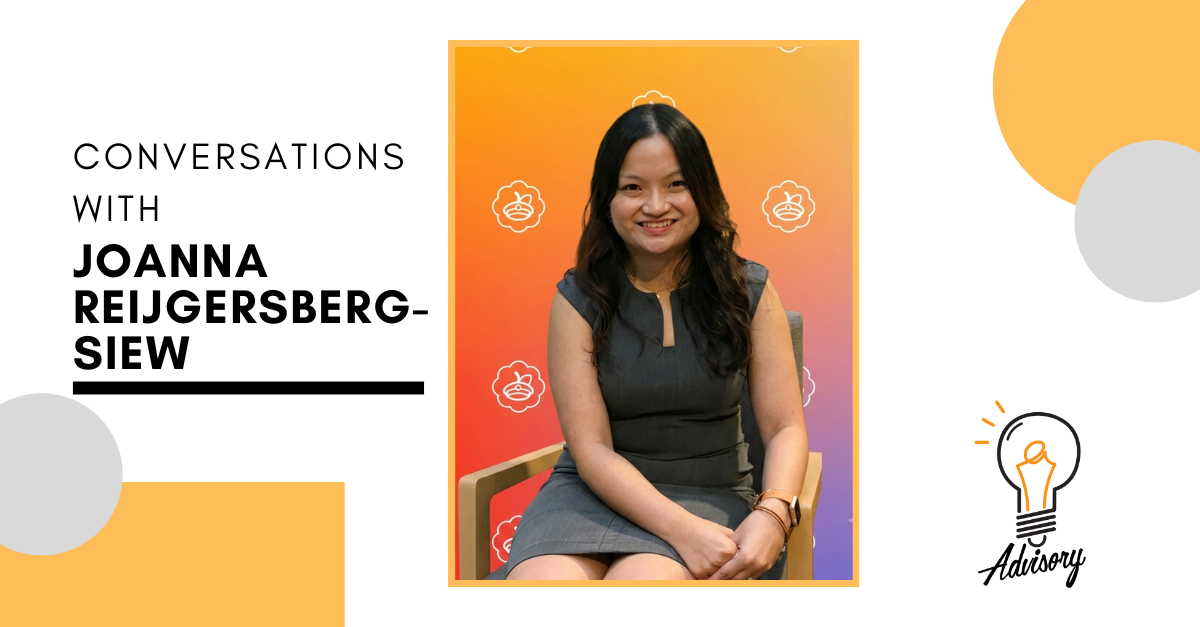
Conversations with Joanna Reijgersberg-Siew
By Damon Chee and Eve Ong
Joanna Reijgersberg-Siew is the founder of Cranberry AI, a company that runs predominantly on agentic artificial intelligence (AI) infrastructure that deploys AI agents to run their operations. These agents are built on Claude and OpenAI platforms and do tasks autonomously with little intervention from humans. In this article, she talks about her reasons for starting Cranberry AI, how agentic AI will change the way we work, and gives advice for those who want to start their own venture.
To start off, could you introduce yourself to our readers?
I am Joanna Reijgersberg-Siew and I am a serial entrepreneur. I run my company, Cranberry AI, with a few sub-companies under it. We build the agentic infrastructure for those sub-companies, which range from e-commerce to training and one-off projects. This involves running OpenAI Codex, Claude Code, agents and servers on my own computer and on cloud computing services, which deliver computing power and software over the internet.
I also lecture at INSEAD and teach agentic AI to PhD students in management. Before this, I spent about 12 years of my life living and working in Europe.
You mentioned spending 12 years outside Singapore. Which countries were they and what did you do there?
I did my masters in computer science at Linköping University in Sweden as I wanted to leave Singapore and see the world. Stanford University was one of my choices then, but I did not apply due to its steep cost. My father suggested applying to European universities instead. Subsequently, I researched, applied, and was accepted to Linköping University, which had the largest computer science faculty in the Nordics at the time.
In the midst of my studies, I wanted to leave Sweden as it was very cold. I was offered the chance to complete my master’s thesis in Eindhoven in the Netherlands, and did so there. After graduating, I stayed in the Netherlands, living in Eindhoven and then Amsterdam, and joined Philips, where I stayed for 12 years. My roles there spanned software engineering, corporate strategy and business architecture. During my four years in corporate strategy, I travelled to about 20 to 30 countries on business, covering China, India, ASEAN, Japan and Australia.
When I returned to Singapore, I led the Internet of Things (IoT) team for Philips Lighting, now known as Signify. IoT refers to everyday objects fitted with sensors that collect data and pass it to other software for analysis and action without human supervision.
What made you decide to set up Cranberry AI?
I studied at INSEAD after my time at Philips and then joined Avanade, the consulting firm set up as a joint venture between Accenture and Microsoft. I was a Senior Director there for about five years and headed AI, IoT and Data for Asia Pacific and Latin America as part of the growth markets leadership team.
When ChatGPT was released in November 2022, I knew it would change the world we live in. I then left the corporate world in June 2024 to start Cranberry AI.
I deliberately chose to bootstrap Cranberry AI, running it the way I want to. I raise money only when necessary and keep as much equity as possible.
What were some ideas you had when you started Cranberry AI?
I originally wanted to raise money for an agentic platform where agents execute payment transactions without human intervention. That would have let me take my company to market with less of a need to figure out details such as marketing, procurement and finance myself.
However, the frontier labs were progressing very fast and several competitors were raising at a scale I did not want to match. I decided not to raise, but to build it with a small team instead.
What are you currently working on at present?
I spend my time running Cranberry AI, which consists of Captain Cranberry, a cookware company, Cranberry Learn, and Cranberry Consulting. Most of my day goes into making sure operations run smoothly and fixing issues before anything crashes as all my companies run on agentic infrastructure.
I also have a couple of other collaborations, such as a risk-based newsletter known as Risky Tuesdays, which I launched with my INSEAD Private Equity Professor, Claudia Zeisberger and Hedge fund & Demographics superstar David Munro. We send out newsletters every Tuesday on risk events globally, which have become particularly prolific due to AI and cybersecurity risks.
Lastly, I am working with an ex-classmate from my Executive MBA class at INSEAD, Dianne Baunbaek, on Cranberry Learn. Dianne approached me early this year with an interest in starting a service business. She has an incredible background in Healthcare and Microbiology which I really admired. We wanted to start off by bringing Healthcare and AI together and that venture became Cranberry Learn.
Who is your target audience for Cranberry Learn?
We run training sessions for senior executives who want to learn more about agentic AI.
They are typically C-suite: the chief executives, chief operating officers and chief financial officers of companies. They do not have the time to take an online course on AI or to go into the deeper technical details of how it works. They want a condensed session that tells them how AI works for their organisation.
What keeps you motivated to run Cranberry AI?
It is fun, because I decide what I need to do with my company every day. This is different from corporate life, where you are paid to work for someone and you know the list of things you need to complete each day.
How do you see agentic AI changing the way we operate in the next five years?
AI and large language models (LLMs) have become a commodity, which makes them very accessible to the masses. At present, though, the user interface for agentic AI is not yet accessible to most people, so they use chatbots such as ChatGPT to do their tasks instead.
This will become an issue as more AI-native companies operate the way Captain Cranberry does, and employees are replaced by AI agents. It will take time as companies have to redesign their workflows first. When it does happen, jobs will have to be restructured and governments will need to create jobs for the people displaced by AI.
How do you think people can balance AI use while retaining their own critical thinking and ideation skills?
Do not outsource all of your thinking to LLMs, even if you feel they could do a better job of thinking and ideating than you. Your brain will atrophy. To succeed now, you need to be constantly thinking, creating and working your mind.
People aged between 19 and 22 generate the best ideas, as they are very idealistic and have a fresh perspective on how things can be done differently. When I think back, my craziest ideas came in that age range, and at 20, I first had thoughts of starting my own company.
What makes an individual take risks?
When an individual has everything planned out in front of them, they are less inclined to take risks. When a person feels they have nothing to lose, they take risks, and great ideas come from that. In this job market, it could be someone who has been retrenched and wants to try something new. When that happens, you see an influx of startups.
If a venture lasts beyond a year and a half, the founders have most likely found a product-market fit.
What advice would you give to those who want to start their own venture?
The most important thing is to start working on something. Prompting a chatbot by hand is not enough, because you have to guide it through every task. When you start an online venture, the agents need to run autonomously, as you cannot be there to fix every error. Begin by installing Claude Code or OpenAI’s Codex, which are agentic coding tools that can build apps. Tell them what you want, let them ask clarifying questions, and execute when the plan is ready.
Also, a lot of people suffer from analysis paralysis, where they over-analyse a situation and never act. My advice to students is to start first and work out the kinks along the way. Some of your ventures will work and others will not. It is okay to fail, but do pick up the lessons from it.