Conversations with Kaan Hoa Kong
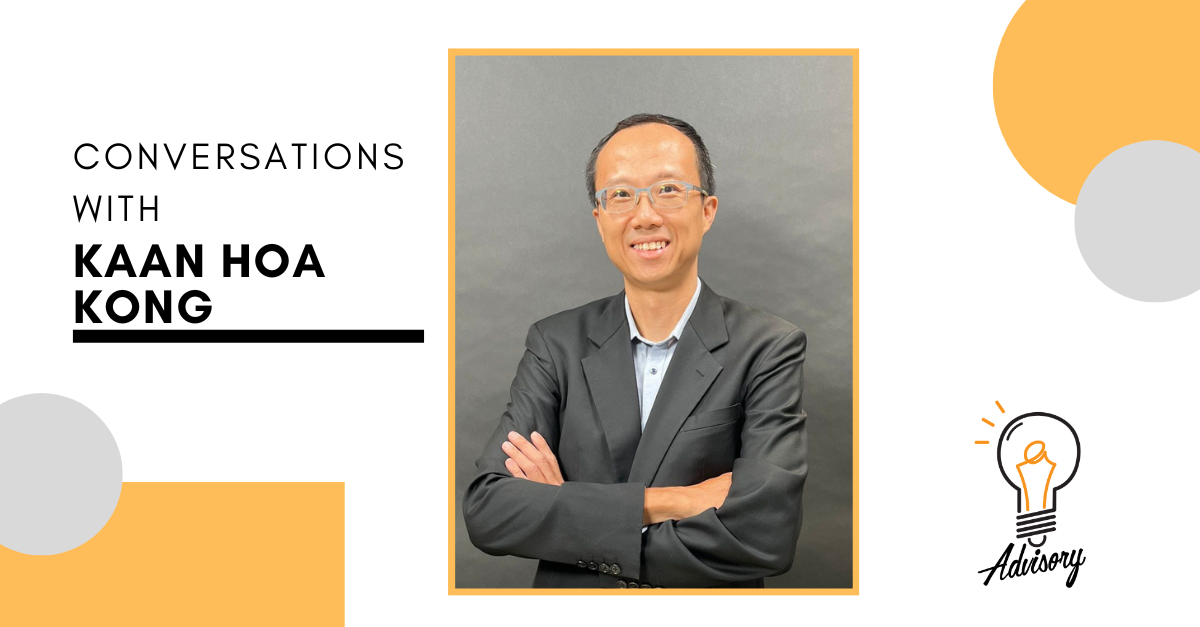
Kaan Hoa Kong is a Senior Investment Advisor at Union Bancaire Privée (UBP), a boutique Swiss private bank. In this article, he walks through his day-to-day life at UBP, the challenges and rewards he experiences in his job, along with advice for those who want to work in the finance industry.
Please introduce yourself to the audience.
I am Hoa Kong, a Senior Investment Advisor at Union Bancaire Privée (UBP), a boutique Swiss private bank that is family-owned. Unlike some of the big banks, we are not publicly-listed. As an investment advisor, I work closely with the private bankers to provide investment advice to clients.
What does a typical day as a Senior Investment Advisor at UBP look like?
A typical day starts with reading up on the markets. I make sure I understand what has happened overnight, along with current news that would impact investment decisions. As the day progresses, time is spent mostly on talking to different clients. At the solution proposal stage, I use what I read, along with the bank’s views, to suggest investment solutions to clients.
The day could also revolve around a client whose investments did not go very well, which would entail updating the client and thinking of recovery methods. Overall, it is a lot of client interaction on the investment front.
What sets UBP apart from other private banks?
UBP is a niche family-owned Swiss private bank, where our main business involves wealth management and private banking.
In contrast, most other banks offer other services such as corporate and investment banking and sometimes retail banking.
Investment banks handle mergers and acquisitions and capital raising for companies. For corporate banking, bankers serve businesses ranging from small and medium-sized enterprises to large companies, primarily for their cash management and credit needs. Lastly, companies involved in retail banking offer financial services to individual consumers.
We prefer to focus mainly on the private banking business.
What do you think is unique about being a private banker in Singapore compared to other wealth hubs?
In Singapore, we have a government that supports strong banking regulations and rule of law. A strong command of English here also helps. This makes clients comfortable in conducting their banking activities here with our high proficiency in English, a global language of the business world, along with the confidence that their assets are safe here.
One of our main competitors would be Hong Kong. Like Singapore, it also possesses a strong financial hub status and benefits greatly from being an offshore financial centre for mainland China. Depending on the Chinese government’s prevailing policies and investors' reaction to them, the proximity to China can work for or against investors.
What are some common misconceptions young people have about private banking or investment advisory?
One common misconception is that a finance or banking background is necessary to enter the private banking industry. While it certainly helps, there are examples of mid-career pivots into the finance industry. I graduated with an engineering degree, and through a combination of networking, willingness to “re-start” and some luck, here I am today.
Another misconception is that you must get all investment decisions right because you are dealing with high-net-worth clients. The truth is actually very far away from this as there will always be wrong investment calls. What is important is aligning clients’ expectations at the start of the investment process, and keeping in close contact with them during times of market volatility, so they know someone is still looking after their investments.
Did you foresee yourself working in private banking after your undergraduate studies?
I did not foresee myself doing so. In fact, I started out in the public service and the opportunity arose by chance after my second job. At that time, I was exploring my options when one of my ex-managers reached out and introduced me to a fairly senior manager in Citibank. I sat down for an interview and they were willing to give me a shot even though I had no banking experience. For that, I am extremely grateful.
This all comes down to the importance of networking, getting to know more people and putting yourself out there for an opportunity, especially for a career pivot.
How did your previous roles, such as relationship manager and portfolio counsellor, bring you to your current role in investment advisory?
I started off in direct sales as an acquisition banker since I lacked prior finance experience. From there, I got a better sense of the different functions within the bank. Subsequently, I moved into a relationship manager role. Although I realised I enjoy interacting with clients, it was the investment aspect that thrilled me most. Subsequently, after a few years, I pivoted towards portfolio counselling and investment advisory.
For people looking to enter the financial industry, it is important to get a leg into the door first via any acceptable role to you. Once you are in, it becomes easier to understand the other opportunities available within the bank, and discover your areas of interest to pursue. It is also easier to switch roles within a bank once you have built up a credible internal reputation and have accumulated sufficient vintage within.
What is one thing you wish someone had told you before you stepped into private banking?
That a finance degree would pave a smoother path into private banking. When I chose an engineering degree, I was under the impression that it would open many career opportunities. However, landing a banking job did not turn out to be easy. While not impossible, it is a more convoluted journey.
The difficulty for STEM graduates, such as myself, is that most hiring managers assume candidates with a finance degree are easier hires because they have been properly trained. However, l argue that the converse is true; the problem-solving skills honed from a STEM education is invaluable in finance, even if the job market realities are different.
How was the transition from your previous engineering role to your first role in finance?
When I first entered the finance industry, I did not have any finance knowledge and had to learn them on my own.
While the bank provided basic training in finance concepts and products, it was inadequate. In order to bridge the knowledge gap and to stand out from the crowd, I took it upon myself to read up on finance on a deeper level. I took the Chartered Financial Analyst (CFA) and the Chartered Alternative Investment Analyst (CAIA) exams, along with a Masters in financial engineering, to equip myself with in-depth financial knowledge.
What did you learn when you furthered your studies in finance?
In the CFA curriculum, we learn finance concepts such as valuation of traditional financial assets like equities, bonds and derivatives, and how to put these together in an investment portfolio, amongst other topics.
In the CAIA curriculum, we focus on non-traditional asset classes that can complement traditional portfolios. These include hedge funds, real estate, commodities such as precious metals and private assets.
In my financial engineering classes, we dug deep into derivatives, options pricing, and structured products. These complemented the CFA and CAIA curriculums very nicely.
Do you think that taking the CFA and CAIA exams are necessary for someone who would like to enter private banking?
For someone without a bachelor’s in finance, I think that passing the CFA exam is useful to show and assure financial sector employers that you possess the requisite financial knowledge. However, it may not be as critical if you already have the requisite finance background.
Nevertheless, having that “quality mark” via a CFA, CAIA or even a master’s degree will certainly help in career progression as these credentials demonstrate a person’s tenacity and desire to upskill themselves.
What is the most challenging aspect of your job?
It would be to update a client when an investment call does not go well and explaining the reasons behind the performance. Nonetheless, this step is imperative in a private banking relationship because a client’s trust is easily lost if a banker or advisor goes radio silent when things do not go well. It is akin to having a “fair-weather friend”. In fact, if reassurance and “hand-holding” is done well during a tough period, it can even strengthen the relationship between the advisor and the client.
What do you find most rewarding about your work in investment advisory, and what keeps you motivated in this industry?
It is when clients return with positive feedback. Often, they come in with their own investment ideas, rightly or wrongly. I will try to challenge some of their assumptions in a professional manner and suggest alternative points of view. It motivates me when some of these suggestions are implemented, the subsequent results turn out well, and the client acknowledges it. It does not happen all the time, but when it does, it is extremely rewarding and motivating.
As an Investment Advisor, do you personally design investment solutions, or do you work with a dedicated team of analysts for market research and strategy?
More often than not, as investment advisors, we leverage off the bank’s views and solutions that the bank has conducted research on to put together a portfolio based on a client’s needs.
Personal views will typically only come in when a client requests information that falls outside of the in-house research scope, with the important caveat that they do not represent the bank’s view.
Do you see artificial intelligence (AI) as a threat or an opportunity for investment advisory work, or somewhere in between?
I see it more of an opportunity than a threat. There are people who predict the fall of wealth management because of increasing AI capabilities. The reality is that AI improves our productivity as it can search for and consolidate information so much faster. Our response to our client is typically faster now than before.
However, wealth management is still a very people-oriented business. For example, while a high-net worth individual can always turn to AI to ask for the best stocks to buy, there are aspects to investing that AI cannot cater to. These include how the stocks should feature in the client’s overall portfolio, blind spots or personal preferences that have not been considered, and what risk mitigation strategies they can consider, amongst others.
Thus, having someone to speak to and bounce off ideas with, having your concerns and worries heard by a person instead of a robot, these are things that clients seek out in a wealth manager.
Would researchers have their work replaced by AI?
As mentioned earlier, you can always turn to AI for help as it can extract a lot of information from online sources and consolidate them together quickly.
Despite this, human research is still valuable as not all information is available online. These may include views and inputs from other analysts which are not publicly available, or access to senior management of a company who may provide nuanced insights that cannot be put into words. One can then overlay this information with the AI-generated content to come up with a more complete picture.
Let us not forget that AI hallucination is real. Sanity checks from human researchers are thus critical to verify the accuracy of the information.
What direction would investment advisory head in the near future and long term?
In the near future, I think it will continue to grow due to the advent of AI as it can automate tasks and increase productivity.
In the long term, I feel that wealth management remains an evergreen industry. As people get richer due to growth in their business or investment wealth, the need for quality and responsible wealth management will only increase. AI will be an important tool to facilitate and not replace this.
What advice would you give to youths who want to build their skills to enter the finance sector?
Recognise how little we know and always be curious to learn new skills. Staying hungry for knowledge is an extremely underrated, yet important trait. Once an individual’s learning stops, they stop growing and become complacent. Things change very quickly and there are always new things to learn.
Focus and mono-tasking is another trait I find useful as most humans are not primed to work on many tasks simultaneously. I prefer to mono-task and prioritise the activity that is the most important. Get it done first, get it done well, and then move on to subsequent ones.