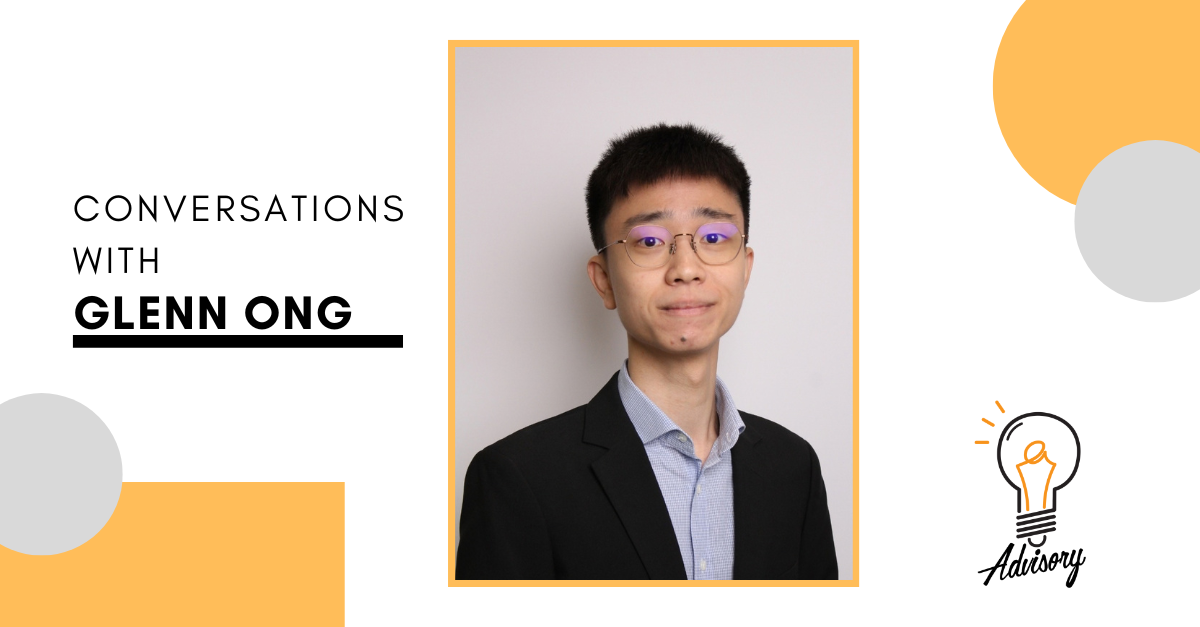
Conversations with Glenn Ong
By Tan Beng Yang and Caleb Thien
In this article, Glenn Ong, Vice President and Lead Intelligence Analyst at Citi, shares his journey in the private sector intelligence sector and the work in this often-hidden field.
Could you give a brief introduction of yourself and your job?
I am part of Protective Intelligence, one of several teams within Citi’s wider intelligence function. Our team anticipates and mitigates risks, focusing on early detection of digital, physical, and reputational threats.
I have three key responsibilities. First, I help to lead the production of analysis that informs business and security decisions at my company. Second, I lead governance, metrics, and impact reporting for my team — this involves working with teammates to define our standards and workflows, measure our output, and convey that impact in a compelling way to demonstrate our value to the organisation. This gives me a bird’s-eye view of our team, which allows me to support management decisions. Finally, I represent the Protective Intelligence team in Asia, as the rest of my team is based in the US and Europe. I execute the team’s priorities in the geography and interface with our company’s leaders. Last year, I had the opportunity to brief a member of Citi’s global Executive Management Team on our intelligence program’s priorities and impact during their visit to Singapore. We usually look at the 6-12 months basis in terms of threats we anticipate.
What does your day-to-day life look like?
Intelligence analysis can be responsive or proactive. For the former, we receive cases that our partners in other departments escalate to us. We then use our tools to produce reports or briefings that help our colleagues plan security mitigations or address investigative questions. For the latter, I lead a workstream that publishes research on how emerging technologies or threat-actor behavior can change the risk landscape in the near future, and we assess how that might be relevant to our company and its leaders. As a lead analyst, I also review my colleagues’ drafts before they are submitted for further review.
The rest of my day is spent on program management. I work with other analysts to update playbooks, track our output, and prepare periodic business reviews explaining how our intelligence has informed business decisions or kept employees and customers safe. The value of intelligence cannot be measured only in quantitative output, so conveying that qualitative impact is critical to further enhance the program. Crucially, it also helps our colleagues feel recognized and motivated.
What are some upsides and downsides of working in your specific role?
One key upside is getting to learn a little about a lot. Intelligence is very user-driven; I get to work with colleagues globally specializing in executive protection, cyber and physical security, crisis management, communications, and investigations, to name a few. You develop empathy by seeing things from their perspective, learn about what matters to them, and build trust — all of which are invaluable. I also get to hear interesting stories as some of my colleagues used to be agents with the FBI or US Secret Service.
Another key upside is having opportunities to conduct analysis and present my findings to our C-suite executives. As an introvert, it’s really eye-opening to learn and observe executive presence from senior leaders.
A common challenge analysts face is that risks and threats don’t take days off, and I have often had to work at night and on weekends, but I have also been fortunate to work for organisations where everyone takes turns providing surge capacity to one another.
Could you walk us through your career path so far and your motivations in selecting each role?
I started my career in a think tank because I wanted to do a PhD and become a researcher or academic. In fact, I still want to do a PhD as a personal goal, not as a career stepping stone, and I might go into academia one day. I had no idea security analysis existed in the private sector, until my university classmate posted about an opportunity at McKinsey in our alumni group chat, so I took a chance and applied. I was drawn to the excitement of working for a fast-paced organisation, and curious about how the private sector produces and uses security analysis. Later, a highly respected mentor of mine had an opening in her team at Citi, so here I am.
I didn’t apply to the public sector side in Singapore because the selection process seemed very opaque and daunting. It was a pragmatic decision to join the private sector. However, there are some private sector roles within US corporations that require US government clearance. There are also some Head of Intelligence positions at multinational companies that require clearance from their home governments to foster cooperation and info sharing. Many of these positions are filled by ex-government officials of their home countries, because it is important for people in these positions to have networks with their public sector counterparts.
How does the role of intelligence analysts differ between the public and private sectors?
The main difference between private and public sectors, for my role, is the objective of my analysis. One highlight during my short stint in public service was supporting a senior researcher in an outreach lecture at a public library; I was really inspired by the mission of using analysis to inform policy and promote citizen engagement. In contrast, the private sector often requires you to think of intelligence as a business and your readers as clients. Client needs can shift rapidly as business priorities change. When a product or format no longer works, we pivot quickly. Intelligence analysis is used to drive decisions and/or to nurture a stakeholder relationship, so in that sense private sector intelligence is more driven by pragmatism. I had to be much more concise with my papers in the private sector.
On the other hand, the means used to gain intelligence can vary greatly depending on the agency you are under. In the public sector, it is possible to deploy personnel on the field. In journalism, teams can be very active, and may even approach people proactively to obtain information. However, in places like banks and manufacturing corporations, we do not engage in covert or extralegal means. Rather, we rely on open-source information, close contacts and sources from academia and think-tanks to write our reports and score our indices.
Compared to the public sector which tries to retain people as long as possible to preserve the tradecraft, in the private sector people move around much more. However, we do not spread tradecraft around either, as each company has its own ways of doing things.
What drew you to the field of security and geopolitics as a student, and are you still motivated by the same factors currently?
I was inspired by a junior college history teacher who made the Cold War feel personal. Watching images of the Berlin Wall falling to the tune of Scorpions’ Winds of Change — and reading about the very material implications of the overarching ideological conflict — made me realize just how much world events affect the everyday.
I think that initial pull factor still holds true today; global events feel increasingly personal. I’m fortunate to be in the right place at the right time, having a front-row seat as intelligence teams help corporations adapt to the global shifts.
As a history student, how does that influence your work, along with other relevant disciplines?
History is not a direct indicator, but history is useful as a precedent to explain to business leaders how events may go. For instance, the history of Russia-Ukraine relations was useful to explain to business leaders who may have thought that it was not rational for Putin to invade. History gives you the context to understand the world as it is now.
International relations may not be directly relevant to the technical aspects of intelligence but it provides useful intellectual frameworks to understand how states behave and provide hypotheses for their behaviour. Even though theories like liberalism and realism may not be correct 100% of the time in explaining the behaviour of a specific state, we can still rely on these theories to structure our explanations of the world.
What are the most important skills or mindsets you have developed to succeed as an intelligence analyst, and how did you cultivate them?
I’ve learned many lessons from successful colleagues, and they can be condensed into three key attributes: Ownership, collaboration, and innovation.
Ownership: I was not a consultant while at “The Firm,” but every employee there is expected to “Make Your Own McKinsey.” This was a significant mindset shift because it forced me to have skin in the game and recognize it is everyone’s responsibility to build, even if you are not in a revenue-generating function. However, you cannot (and should not) just be building things for yourself, which leads to my next point.
Collaboration: A mature intelligence team typically offers a variety of products, led by different analysts. Stakeholders who approach us with a problem may not know which product(s) best serves their needs. My manager once explained that thinking strategically, in our context, means actively identifying opportunities to bring other teammates into the fold when their products can supplement yours to add value to a user. Collaboration makes colleagues feel valued, and is a force multiplier to solve a problem and deepen a relationship with the end-user so they will come back for more (and spread the word about your services).
Innovation: Another mentor once stressed the importance of being an agent of progress. This refers to the mindset of embracing change, the practice of conducting R&D, and driving implementation compassionately and responsibly through robust governance and support. A successful analyst may not have to do all three simultaneously or indefinitely, but such experience will help one develop substantive knowledge of tools and tradecraft, and be able to engage with vendors authoritatively.
How is the role of an intelligence analyst evolving with the rise of generative AI?
This will depend on the amount of resources an intelligence team has access to and their employer’s business priorities, but one probable scenario is that the future analyst will be running a team of GenAI agents, each handling one or several components of the five-part intelligence cycle (Planning, Collection, Processing, Analysis, Dissemination). The good thing about AI is that it helps us to filter information and produce insights, differentiating between signals and noise, and makes the work much faster.
In this scenario, relationship-building and critical thinking skills might become even more important. It might not be ideal or plausible for GenAI tools to replace the analyst in planning, analysis, and dissemination phases, where strong relationships between analysts and their stakeholders will lead to better feedback and more fruitful outcomes. That said, GenAI tools are expensive and their access within organizations may not remain universal indefinitely. I would encourage aspiring analysts to continue developing core skills like evaluating sources, writing concisely and objectively, and openness to feedback.
How might generative AI and other factors influence the threat landscape you face over the next 5 years?
My personal take is that misinformation and disinformation might become even more pervasive. Just as the people protecting organizations are using GenAI to automate their processes, so too are threat actors identifying ways to become more efficient. This could result in higher volumes of threat actor activity, at a higher quality too.
For example, threat actors are increasingly leveraging AI tools to create highly convincing audio and visual deepfakes, which have proven effective in financial scams targeting companies and individuals. We’ve seen many cases of AI being used to impersonate C-suite executives. AI may also make it easier for threat actors to obscure their identities. Intelligence analysts may have to invest in horizon scanning capabilities to help their organizations stay ahead of these trends.
What advice would you give to your younger self just starting out in this field?
Embrace serendipity: I did not set out wanting to join this industry, but I followed my interests, and my curiosity led me here. Swim outside your lane: You may have multiple careers in your lifetime. I love my role but am fortunate my organization invests in cross-pollination for our development, allowing me to take on stretch assignments in functions like crisis management and even executive protection. It is important to expand your horizons if you have the time and mental space to do so.
I think people who gravitate towards this kind of work start out wanting to do geopolitics as a career, like helping companies navigate geopolitical risks. But what you quickly realise is that geopolitical consulting typically goes to people who have served for some time in government and therefore have policy experience and high level contacts. Security intelligence comes very close and also adds significant value to businesses. I personally never heard of this kind of work until someone from my class shared this job with me. Companies need intelligence to make decisions about things like whether to institute work from home, for the safety of employees or where to put their office.
What are three actionable steps that youths can take today to prepare for a career in security and geopolitics?
I would encourage aspiring analysts to:
Reach out to people in the industry for information on networking events, then join the ones that are relevant to your interests and aspirations.
Learn about the different employment categories (consulting, embedded, in-house) and speak to different analysts to understand what works best for you.
Conduct research on a company’s business (what it sells) and operations (where and how it sells its products or services). Analysts who fare well in job interviews tend to tailor their analysis to relevant business priorities.