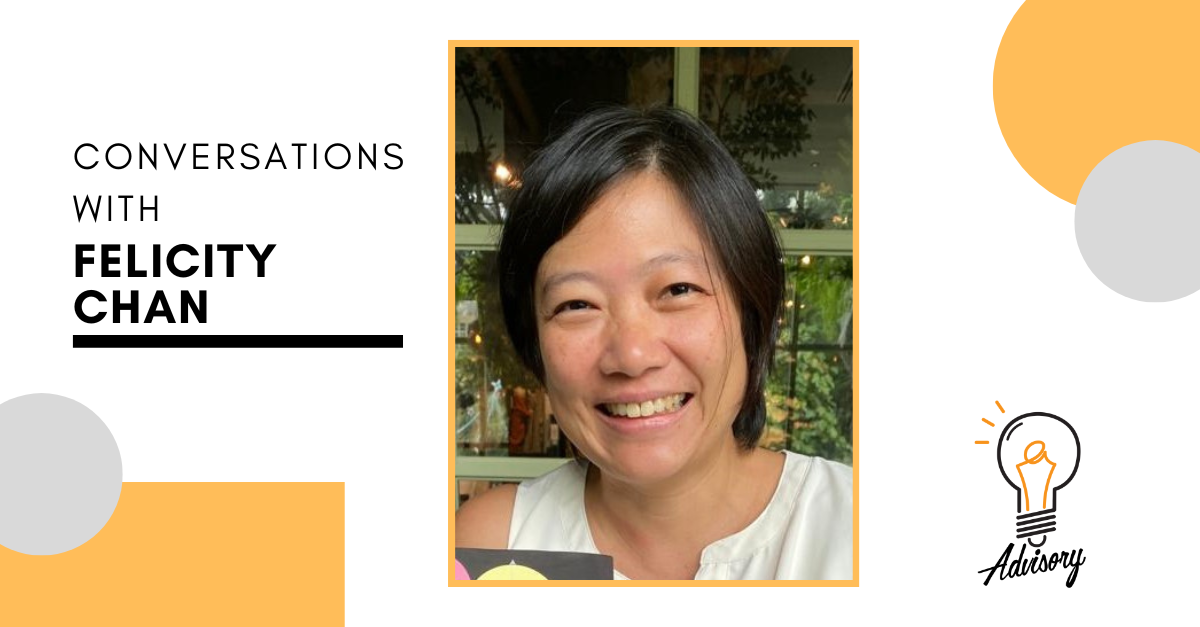
Conversations with Felicity Chan
By Tan Beng Yang and Ryan Lei
Dr Felicity Hwee-Hwa Chan is a researcher, educator, and urban planner whose career has spanned the Urban Redevelopment Authority (URA), US and European research institutes, Nanyang Technological University (NTU), and the Singapore University of Technology and Design (SUTD). She founded Topo-Phi, a new venture to continue her research on urban belonging and interest in socio-spatial planning. In this interview, she shares about her journey into urban planning, and the joys and tensions of academic life.
Could you tell us more about your day-to-day life?
As an academic, multi-tasking is expected as a professor has to do research, teach, and undertake administrative tasks, which include directing academic programmes, reviewing curricula, managing budgets, and meeting student needs outside the classroom. For example, programme creation and curriculum reform require a lot of time investment as you need to create and review content, as well as seek buy-in and collaboration with many colleagues and the University Administration.
Thus, there is always a time competition and trade-offs that an academic has to make among research, teaching, and administration. For example, in the first two years of reforming the programme and curriculum of MSc in Urban Science, Policy and Planning at SUTD, about 70 percent of my working week was handling administration-related work. It was a constant battle to set aside time for my research and teaching.
In this new season of my professional life, I decided to start Topo-Phi to formally continue my professional interest in urban planning research and education, springboarding off my recent research project on mapping urban belonging in Singapore. I envision Topo-Phi as a novel platform to advance thinking and development of urban planning in Singapore, especially in terms of public education.
What would you say are the upsides and downsides of your work?
The upside is getting to know and work with people, particularly through my teaching engagement. I may not be able to remember every student whom I have taught, but having the chance to be a part of their life journey, even in a small way, matters greatly to me. In addition, teaching refines and deepens your knowledge domain because by having to teach and explain, I have discovered the knowledge gaps in my understanding of the subject matter. Students are seeking wisdom in addition to knowledge in the classroom. Thus, I think to teach effectively and insightfully, it requires integrating life experience with one’s knowledge domain.
The downside in academia is the heavy workload, such that even working late nights and weekends would still leave you feeling inadequate. Most top-ranking universities are research-focused, yet a major role and responsibility of a university is also to educate. While there is an abstract symbiosis between doing research and teaching, it is a practical challenge within the confines of time to execute both well: should you spend more time teaching outside the lectures because students want more and you want to give more, or should you limit your teaching commitment so that you can move ahead with your research publications and grant applications to advance in your career to become a tenured, and eventually a full professor?
What drove your career changes as you moved between practice and research?
I have been strongly interested in Geography since Junior College, particularly urban planning and development. I went on to pursue Geography and Southeast Asian studies at NUS, as urban planning was not offered as a programme of study in Singapore. When I graduated, I applied to URA because I wanted to understand how urban planning actually works before taking a definitive step to do a professional degree in urban planning, which I did eventually at the Harvard Graduate School of Design.
While I enjoyed the professional environment because of the immediate and real urban challenges to solve, I came to realize that I missed having time to read, to ask questions, and to deeply and critically reflect on propositions. Life has its unexpected twists and I found myself in a set of life circumstances that allowed me to pursue a PhD and do urban planning research outside of Singapore.
What are some principles you have held in your work throughout your career?
Having good relationships at the workplace is important to me. This means giving and showing respect for those above, below, and around you as a fellow human being who requires dignity and authenticity in how you speak with them, write to them, and work with them. Unfortunately, this is something I am seeing less and less at the workplace over the years.
Another principle: What is worth doing, is worth doing properly and doing well. Good things take time and care to make.
To what extent do you feel like your research shaped policy decisions in Singapore?
I think most researchers in applied fields work with an intent to inform policy-making beyond publishing the research findings in scientific journals. I am no exception. I don’t think my research has yet shaped policy decisions in Singapore, but I hope it can and will. Doing research is a future-oriented venture that is like sowing seeds of knowledge that can take years after planting to harvest. All the while, times are changing, and what might be inappropriate once, becomes suitably appropriate at a future time.
Urban planning can feel abstract to many young people. How would you explain urban planning to a student?
I would define urban planning as a process of making decisions and building consensus about how a city should use the space and land around us based on the present and future needs and desires of civil society, the market, and the state. It values equity, sustainability, and inclusion – social, economic, political, environmental, cultural, spatial. I think what makes urban planning exceptional is also its concurrent engagement with multiple scales and dimensions, such as at the strategic policy level on the national level, as well as at the local scale of a neighbourhood through physical interventions, for example, deciding where a market or urban plaza should be located and how it could be designed to enable social interaction among neighbours.
Do you face difficulties teaching about urban planning, given that it is less well known in Singapore?
When I offered an undergraduate 101 urban planning course at NTU, many students took the class as an elective to check out the field. There were about 50 students in the introductory course yearly. A handful of students were very interested and continued on to take the higher-level modules which I offered. I had one student who took every course I offered - a total of four. In fact, she inspired me to create my fourth course so I could teach her as much as I knew how and within the undergraduate timespan. She went on to become an urban planner! These passionate students, albeit a handful, inspire me to do more and keep teaching!
At the master’s level, it was a very different experience. Most students arrived with a clear intention to learn more and dive deeply into specific topics. Some of them had some professional experience. In these classrooms, I was able to do more critical discussion about the application of theory in practice.
What advice do you have for students who wish to be academics or urban planners?
Urban planning is very meaningful in its ability to improve people’s lives, but there will be times when you will feel powerless to make the change you hope to (like any other job), so there needs to be a degree of intrinsic value you find in the field to sustain your passion. Urban planning is fundamentally a people-facing role, negotiating with stakeholders and understanding the needs of the community, so you need to genuinely enjoy learning about people and working with them to thrive in urban planning.
Comparatively, in academia, you will expect to spend more time working on your own. However, collaborating with many domain experts is now expected in most grant applications. It is important to be clear-eyed about the demands of academia: producing research findings speedily, which also means you need to get a steady flow of grants, in addition to teaching, mentoring, and managing administrative responsibilities.
What are some actionable steps that youths who are interested in academia or urban planning can take?
Read widely – there are a lot of insights you can obtain about academia and urban planning from literature that is available online. You should also try to read beyond what is happening in Singapore, and to think about the differences, limitations and characteristics of the way things are done in Singapore and how they are done overseas.
It is also important to talk to people who have experience in these fields. These conversations fill in the gaps that reading cannot: such as the differences in opportunities between urban planning in the private and public sectors. Be open-minded and unafraid to ask questions, and be ready to learn from people who have walked this path before.
Internships are important as well – on-the-ground observation allows you to see for yourself some things that people are not able to convey entirely through words. This includes how day-to-day operations are conducted.
At the end of the day, I think the most important thing is to follow your gut instinct. Ultimately, other people’s paths are not your own. Take a courageous step towards what calls you, and know that if it does not turn out to be what you want, take courage yet again, to pivot.