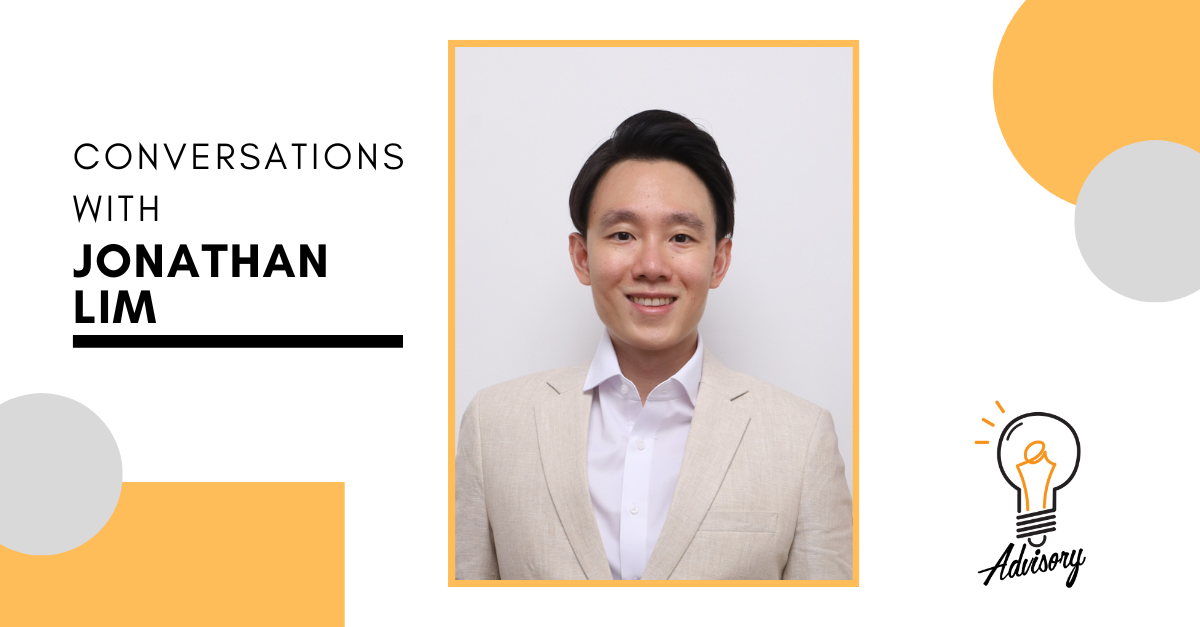
Conversations with Jonathan Lim
By Tan Beng Yang and Andre Nyeo
Jonathan Lim is a Market Director at Singapore Global Network (SGN), a division under the Economic Development Board (EDB), covering Singapore, Australia and New Zealand. In this interview, Jonathan shares about his journey in the public service and his role in deepening Singapore’s global community of family, friends and fans.
Could you give a brief introduction of your role in SGN?
SGN is a global community of over 250,000 individuals, comprising Singaporeans and friends of Singapore from all walks of life, whether you are a student, working professional, entrepreneur, wherever you are in the world. I am the Market Director for Singapore, Australia and New Zealand at SGN. In this role, I lead engagement efforts on the group, maintaining and cultivating relationships with community builders and partners, as well as both local and international stakeholders. We are usually on the ground at events, and we are the face of the organisation when we meet new people across our work.
What does your daily life look like?
My days vary depending on whether I'm working from home or in the office. On work-from-home days, it's usually project follow-ups and virtual calls. On office days, I could have back-to-back internal meetings, calls to discuss upcoming partnerships or events, and coffee chats with people in my network who are visiting Singapore.
During peak periods, my days get packed with events that SGN organises or supports, which typically take place on the sidelines of major industry conferences such as the ATx Summit, SuperAI, SWITCH (Singapore Week of Innovation and Technology), and the Singapore Fintech Festival. These events range widely in format, but networking is always a big part of it.
With my overseas portfolio, I also travel to Australia a few times a year — usually about a week per trip — to connect with our community there, be the bridge that keeps them plugged in to Singapore, and of course take part in our National Day celebrations in various cities. Much like the conference season back in Singapore, August tends to be another peak period for me because of this.
What are some notable aspects of your job?
My job at SGN requires a huge focus on stakeholder management, and I carry a lot of responsibility representing SGN (and of course Singapore), whether I'm here or abroad. This means learning who my stakeholders are and how to carry myself, since I meet people from all walks of life, each with their own dispositions and ways of operating — and I've learned to be adaptable and read the room accordingly. At the same time, having grown up and studied in Singapore my whole life, I've found that this job — through the range of people I meet — has broadened my perspectives in meaningful ways I didn't expect.
There's also a lot of operational decision-making — shaping events and formats around the audience, the community, and the outcomes we're ultimately trying to achieve. For someone like me who isn't naturally an extrovert, weekdays can be socially draining, so I like to spend my weekends resting at home. Regardless, it means a lot when win-win-win outcomes are secured. And from time to time, people come up to us with a word of appreciation, affirming the importance of the work we do as community builders — selling the "SG brand" at every stop along the way.
Looking back on your time at SGN, what has made you the most proud?
In our roles as Market Directors, we spend a great deal of time actively seeking out partners — organisations, communities, and individuals we can collaborate with. On the other hand, SGN has built a good reputation because of the work of my predecessors and colleagues. Some of the passionate individuals we've worked with are people we met either by chance or through casual introductions at other events — true multipliers who've helped us extend our reach far beyond what we could do alone.
This was especially true when I first took on the ANZ portfolio and was getting introduced to the region as a newbie. I was struck by how willing people were to step forward — to make a connection, give their time, go the extra mile, and show me the ropes as I found my footing. Looking back, I'm proud of two things: first, the good foundations that have been laid, hearing how people speak well of SGN's community-building efforts, and when friends of Singapore speak well of us (though of course, no society or system is perfect); and second, the sheer kindness of people who step forward to help, often going above and beyond.
What drew you to study geography, and how does it help you in your work?
Truthfully, I didn't choose geography in university because I thought it would directly shape my career — like many undergraduates, I wasn't sure exactly what I wanted to do, so I chose to study something I genuinely enjoyed instead, and figured I'd work out the career part later (I know this was a bit of a gamble, but I'm glad it turned out well). Specifically, as a human geography major, I got a peek into other disciplines like sociology and political science, and along the way, I made some lifelong friends too.
Why did you decide to join the public service?
Joining the public service wasn't my initial intention — it came about through more of a series of coincidences than a deliberate plan. After my GCE 'A' Levels, I had applied for a Ministry of Home Affairs (MHA) scholarship, but wasn't successful. During my NS and early university years, I remained keen on joining the Singapore Police Force (SPF) after graduation, and did an internship with them during my summer break after my first year of university. But once I'd completed it, I realised policing wasn't something I wanted to pursue after all.
During my final year in university, I turned my focus to applying for roles in the private sector instead. However, my interviews didn't progress past the final stage. Around that time, an acquaintance — who was then working in the Prime Minister's Office (PMO) Communications Group — reached out for a coffee chat, having heard I was graduating soon, and mentioned an opening on the communications team he was leading and hiring for. I wasn't particularly set on the idea at first, but decided to give it a shot anyway and keep an open mind. In the end, it turned out to be the only offer I received — and in hindsight, a fortunate one, since COVID-19 hit the following year, and I was fortunate to have kept my job through it.
How did you decide your progression through different public service agencies?
At PMO, beyond communications and engagement, I took on a few other projects across different teams in the division — including data-related work — to build capabilities adjacent to my core role and prepare myself for future opportunities. Three years in, I used my SkillsFuture credits (yes, do make full use of them!) to take a part-time specialist diploma in data analytics at Ngee Ann Polytechnic. Partly, this was because I wasn't sure what I wanted to pursue next in my career — so out of practical reasons, I figured picking up a complementary skill would give me more options down the road. I remain grateful to PMO for giving me a safe space to explore different things. Combining data analytics with comms-related work was an option for me at the time, but I chose to keep it as an option card rather than pursue it in haste until I had considered more options for myself.
After around four years at PMO, I started looking for roles that would give me new experiences to fuel my professional growth. I met up with an ex-colleague who'd moved to EDB and learnt about an open role at SGN, which sounded like something fun. So I applied — and the rest is history.
What advice do you have for youths interested in communications?
While there's a significant writing element to the job, you also need to be able to work with a diverse range of stakeholders and understand how different people think. In today's era, communications goes hand in hand with engagement — events, face-to-face interactions, and so on. As such, figuring out how to build rapport is extremely important. Some people take longer to warm up to you, and others come with their own perspectives and biases. Once you've earned their trust, though, things become a lot smoother — people start sharing their views more candidly and in a timelier way, and when you call on them for help, they're far more willing to come through.
As a communications practitioner, we're always trying to uncover what we don't know, because addressing those blind spots helps clear up misconceptions before they become a problem. That said, we'll never have complete information — knowing how to do our jobs well with whatever information we have is just as important.
What are some misconceptions that youth may have about the public sector?
When I was in university, I held the notion that government work was inherently bureaucratic, and that I'd lack autonomy or creative space in how I went about my work, given all the "layers" involved. Perhaps I've just been fortunate, but my personal experience in the public sector has gone against these notions.
Despite being a fresh graduate, I was given new opportunities at PMO to grow and take on greater responsibilities, including being entrusted to lead certain initiatives independently throughout my time there. That agility proved particularly valuable during the COVID-19 pandemic, when information was changing at a rapid pace. I was fortunate to have directors and managers who were genuinely supportive, who cared about their officers, and were willing to back new ideas. I still stay in touch with them till today and am grateful they took a chance on me and gave me so many opportunities. A large part of why I stayed as long as I did comes down to this: my experience ended up proving those misconceptions wonderfully wrong.
That said, the public sector is very large, and each agency has its own culture. At PMO, my bosses maintained a very open-door policy, and I found it easy to approach senior management directly — the structure was flatter than I'd anticipated. At SGN, the way we operate is more reminiscent of a small company or startup — without too many layers of operating hierarchy, and as a division that brings many functions under one roof. For instance, SGN has its own strategy and planning team, a digital marketing team that looks after our social media channels, a branding team, and a digital products team that helps us with the various digital tools we use. My current role has also given me even more latitude to shape the agenda and the projects I want to take on, and more room to creatively bring together different stakeholders for cross-collaborative work — benefiting our communities in Singapore and around the world.
Do you believe that one must be a scholar to succeed in the public service?
This is a widely discussed topic, and it's true that getting a scholarship gives one a stepping stone to kickstart a career in the public service. It's understandable, then, why many see a scholarship as the key to doing well in the public service. But having one doesn't, in itself, guarantee success. There are many public service officers who didn't get scholarships, myself included, and still go on to do well in their careers.
To me, success isn't necessarily about how fast I “climb” — it's about finding fulfilment in what I do, enjoying the environment I work in, and being trusted to bring value and take on new opportunities. What's served me well in getting there is staying nimble and keeping an open mindset. At the end of the day, what matters is being able to do your job well, and making sure that work is visible to the people around you. Beyond the scholarship question, I think it's just as important to manage people (be it upwards or laterally) and communicate the value you bring — so that others can see it too.
What are some actionable steps for the youth to join the public sector?
It's important to try the work out for yourself — there are plenty of internship opportunities across various agencies. Beyond just completing your work during your internship, take the time to speak to the people around you (take your coffee and lunch breaks seriously!), to hear their stories and unfiltered experiences. Once you've had enough exposure, you can form your own assessment of whether a particular role or bucket of work is something you want to do. And even if you're still not sure, that's okay too. It’s perfectly alright to take a leap of faith. Keeping an open mind and trying as many things as possible really matters. Through that process, you'll discover not just what you like, but also what you don't like and where your strengths lie.
I wasn't sure if communications and engagement work at PMO would suit me (I majored in geography and not communications), but I took the leap, trusted a good boss, and let myself be coachable. Through that experience, I realised that being in a front-facing engagement role was one of my strengths, so I doubled down on it. Moving on to SGN built on that existing strength, while giving me a different operating environment to grow in.
Regardless of which career you end up in, keep as many warm relationships as you can and try not to give in to your biases or preconceived notions too quickly — you never know when these connections might come full circle into something meaningful. Singapore is a remarkably small place; you're rarely more than three names away from anyone you're trying to reach. And if you discover a new interest or passion along the way, go for it. Life’s too short for regrets. If you don't try new things, you'll never know what you're truly good at.