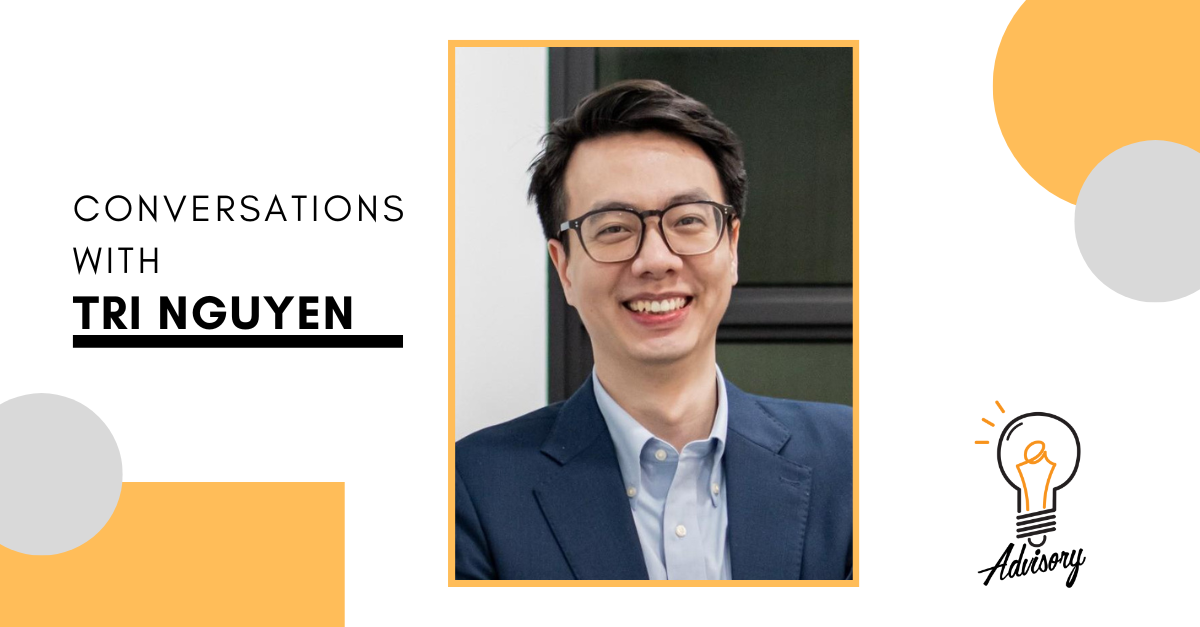
Conversations with Tri Nguyen
By Damon Chee and Ryan Lei
Tri Nguyen is a Senior Manager of Market Development at Wärtsilä Energy. In this role, he works with governments, utilities, and energy developers to shape the energy transition with the right mix of technologies. In this interview, he shares his day-to-day work at Wärtsilä and why you should pursue a career in the energy industry.
Please introduce yourself to the audience.
My name is Tri Nguyen, and I am currently leading Wärtsilä’s market development activities across Southeast Asia. Before relocating to Singapore, I studied and worked in Europe for almost a decade.
What is Wärtsilä Energy?
Wärtsilä is a Finnish energy company that operates worldwide, with one of its main business lines being the energy sector. The company provides flexible solutions that help balance the variability of renewable energy, including flexible Internal Combustion Engine (ICE) power plants and Battery Energy Storage Systems (BESS). ICE power plants operate on the same principle as a car, just at a vastly larger scale: they burn fuel to generate electricity on demand. BESS are akin to the batteries that you find in a laptop, but are large enough to power an entire city.
The energy industry has undergone a lot of change due to the rise of renewables. In the past 10 years, the cost to generate electricity from renewables has reduced by about 80 to 90 percent. Now, solar has become the cheapest source of electricity production.
However, generating energy from solar and wind is not stable, and their output will drop immediately if a passing cloud blocks the sun or if the wind stops blowing, which can cause a shortfall in meeting energy demand. Should this happen, the BESS releases stored energy into the grid to meet demand. For larger or longer shortfalls, our ICE plants kick in, and together, both technologies form the safety net that keeps the grid reliable as more renewables come online.
How is the energy transition scene in different parts of the world?
The pace of the energy transition looks very different depending on where you are in the world. In Southeast Asia, governments recognise the importance of net zero, but many are still ironing out their electricity regulations. Comparatively, countries like Singapore and Australia are in a better position, with more liberalised electricity markets that make it easier to attract private capital and introduce new technologies.
However, conflicts around the world are complicating matters. Many countries are prioritising meeting their current energy security needs over long-term transition goals. The silver lining is that it is also accelerating the case for renewables in some places, as more governments are realising that they cannot rely on imported fuels, and domestic renewable energy can provide greater power autonomy.
Singapore is an interesting case. To aid its energy transition, the country is pursuing nuclear and hydrogen energy as longer-term options, which could create opportunities for those seeking careers in the energy sector. However, its success is limited by two factors. First, safety concerns from using nuclear power due to Singapore’s limited land size. Second, the high cost of generating electricity with hydrogen due to the inefficiency of the production process and the lack of infrastructure.
What would a typical day look like for you at Wärtsilä?
No two days are the same in my role.
On certain days, I spend time getting up to date on market developments in the industry by researching new regulations and policies, as well as reading industry reports. On other days, I would be travelling overseas to cities such as Manila, Hanoi, or Jakarta to meet with energy regulators to discuss energy developments.
During my meetings with these government officials, we would discuss how the energy industry would look like in the future, along with the policies and technologies the countries need to meet their net-zero goals.
How would your meetings look like with private companies instead?
When I meet with private companies, my main purpose is working together to find the right solutions that help them generate power more cost-effectively, dispatch more flexibly, and meet their sustainability commitments. What I do depends on the stage of the discussion between company representatives and me. In the beginning, it would be learning about the difficulties they are facing and sharing Wärtsilä’s experience and expertise in this field. In later stages, should companies be interested in purchasing Wärtsilä’s products, I would pitch them.
What motivates you in your work?
The decisions we make on the products we build to generate electricity will have an impact on our descendants. It is therefore important that everyone works on net zero.
Although you may not see how the efforts you put in now will benefit people, it does pay off in the long term when governments adopt policies that you have long advocated for.
These are instances where it brings me satisfaction that cannot be measured by numbers.
What skills are needed for your role?
To model energy systems, many regulators and utility companies use PLEXOS - an industry-standard tool for power system simulation. I am PLEXOS-certified myself, which allows me to speak the same language as the modellers. In addition, most of my work uses Excel to conduct financial modeling, calculating the cost of producing electricity and electricity tariffs, among others. I then analyse these data to distil and obtain key takeaways from them.
I subsequently use PowerPoint to translate these data to tell a story that resonates with clients I meet to generate buy-in for our products, an intermediate step before sales are closed by the sales department.
One non-technical skill that is needed is networking. Companies need to work with other energy firms, industry associations, and regulators to find collaboration opportunities, as no single entity has the financial means and expertise to handle the energy transition alone. Attending events such as conferences and networking sessions allows you to meet people to find these collaboration opportunities.
What is the one interesting thing that you have encountered in your work?
It was my work trip to Ulaanbaatar, Mongolia. Mongolia is one of those countries that is rich in history, the birthplace of Genghis Khan and the Mongol Empire, yet I realised I knew very little about its current situation. I had to do research about the country and run power system modelling work before my meeting with the Minister of Energy.
Interestingly, I found that Mongolia has high wind speeds as it is located under a jet stream, which makes wind a possible source of renewable energy generation. However, the country faces challenges in its energy transition due to its size and remoteness, heavy reliance on coal, lack of infrastructure, and frigid winters, which can reach a low of -20 to -30 degrees Celsius. It would be costly to make equipment that can withstand extreme temperatures, let alone transport it to cities over long distances.
What our PLEXOS modelling work showed is that there is a viable path forward. A gradual addition of wind power, flexible combined-heat-and-power engines, and BESS into the system could provide both electricity and heat through the brutal winter months, while lowering overall system costs, reducing emissions, and cutting Mongolia’s dependence on coal.
How has Artificial Intelligence (AI) helped you in your job?
AI has not changed my job scope much, as part of it requires me to network with people. Instead, it has complemented my work by helping speed up research. In the past, it would take me days to read up on regulations and reports and cross-check them. With AI, I can conduct my research in hours.
I would caveat that the quality of the AI output rests upon your ability to prompt it by asking the right questions. Remember that you cannot trust what AI says wholesale, and you need a subject matter expert to guide the AI to return accurate output.
Do you think AI will affect entry-level jobs in the industry?
For entry-level data-matching jobs, AI might hit them the hardest since basic work will be the first to be automated. However, it also brings opportunities: young people can use AI to produce research and analysis in a much shorter time and at a higher quality. The important thing for youths now is being able to leverage AI to maximise their value and productivity.
Adding to my earlier point about assisting in research, you can also use AI to automate company processes and work streams to improve your productivity, or to bring new ideas or new ways of doing things.
You have a business and economics background. Is a technical or engineering background needed for your role?
Initially, working in the energy industry was not my first choice. I had tried working in corporate strategy and consulting, where I enjoyed problem-solving but missed a sense that the work was connected to something larger. A mentor suggested I look at the energy industry, and was very helpful in introducing me to the industry and guiding me along.
When I first joined the team, I was the only one without a background in engineering. There was a steep learning curve at the start because my job scope fell in between the commercial and technical aspects of Wärtsilä’s work, and there was a lot of engineering jargon to learn.
However, the workplace culture at Wärtsilä is very supportive, which smoothed the transition process for me. They believe in their employees and gave me ample time to adapt to the new environment and learn from my colleagues.
How would you pitch to people who are interested in working in the energy industry?
The energy industry is dynamic and driven by constant technological changes. There is still a lot of uncertainty in the field, and we do not have solutions to every problem. Thus, there are always new and interesting developments to engage with and meaningful opportunities to contribute to solving them.
To me, that provides a sense of purpose in making a positive impact on the world. If this resonates with you, maybe you can give the energy industry a shot!